Self-hosting an AI model needs a service boundary, not just a running process
Current vLLM and Transformers guidance turns self-hosting into an examination of interfaces, loading risks and the authority an application actually grants.
A model server can return its first answer before its operators know which interfaces they have exposed. That is a poor moment to discover that the demonstration's access key protects only part of the server. Downloadable weights create useful deployment choices, but the application still needs a boundary between a person, a document, a model runtime and any action that follows.
The current [vLLM security documentation](https://docs.vllm.ai/en/latest/usage/security/) makes one concrete limitation explicit: its API-key option does not authenticate every endpoint on the same HTTP server. The documentation warns against relying on that option alone. This is a version-sensitive operational fact, not a claim that every installed vLLM release has identical routes.
Inventory the service people can reach
For a real deployment review, record the runtime version, enabled interfaces, network exposure and the application routes that call it. Identify which requests should be possible and which should be denied. A successful chat completion proves little about an administrative, diagnostic or alternative inference route that was never examined.
The reader does not need to expose a server to learn this lesson. A proposed architecture can first be reviewed using public documentation and a controlled environment. Installation commands and public-network defaults should not be copied blindly from a model card into an organisational service.
Loading a model can involve code
The [Transformers security policy](https://github.com/huggingface/transformers/blob/main/SECURITY.md) distinguishes remote artifacts from modeling code. It recommends safetensors and reviewing custom modeling files when trust_remote_code is required, with a revision specified. This is a narrower statement than saying a popular repository is safe to execute.
The [safetensors documentation](https://huggingface.co/docs/safetensors/index) describes a tensor-storage format designed as an alternative to pickle. Choosing that format addresses one loading risk. It does not certify an entire application, review separately executed Python, authenticate a server or decide whether the input documents may be processed.
A fictional archive defines a read-only role
Imagine a small public-history archive in Dakar proposing an assistant for adult volunteers. The example is fictional. The materials are invented exhibition notes, and the assistant's only task is to draft a short answer with a reference to a supplied note. Volunteers can edit the draft; the assistant cannot publish a page or alter the catalogue.
That limited role makes the acceptance question concrete. The archive is not trying to demonstrate a general autonomous agent. It wants to know whether a person can see which material supported a draft and recognise when the material does not answer the question.
Make the artifact recoverable
The archive's release record identifies the weight revision, tokenizer, model configuration, runtime, application and document collection. It retains the previous accepted release. A change in any of those inputs can change the service's behaviour, so a model name alone is insufficient for an incident report.
For a replacement maintainer, the useful question is whether the accepted configuration can be reconstructed without guessing which files were downloaded months earlier. The record should explain which dependency versions were tested and which installation instructions were merely consulted. Reading documentation is not evidence of a successful installation.
Documents are evidence, not authority
[OWASP's prompt-injection guidance](https://genai.owasp.org/llmrisk/llm01-prompt-injection/) describes the risk of attacker-controlled instructions influencing a language-model application, including through external material. The archive's design should therefore keep document content from granting permissions or redefining the assistant's operating role.
In the fictional exercise, one note includes a sentence telling the assistant to ignore its task and publish an announcement. The expected result is still a read-only draft, with no publication capability available. A successful refusal message is useful, but the stronger application boundary is that a generated suggestion cannot itself acquire a publishing credential.
Keep retrieval and access aligned
Suppose the archive later adds material restricted to a small staff group. The application must decide which documents the current reader may retrieve before presenting them to the model. Asking the model to keep a secret after providing it to an unauthorised request is not an adequate substitute for that access decision.
The demonstration should remain on invented public notes until the institution authorises another scope. Self-hosting does not establish consent, data rights or a retention policy. Those decisions need their own owners and evidence, even when no external model provider receives the material.
Test interruptions as ordinary work
The volunteer enters a question and waits. If the runtime is unavailable, the interface should preserve that question and explain that a draft could not be prepared. It should offer a safe retry of the read or a route to the source notes. It should not expose a framework traceback or claim that the archive contains no relevant material.
An interrupted answer needs a visible status too. A paragraph cut off by a timeout must not appear as an approved complete response. The archive can retain a draft for review while clearly distinguishing it from a finished answer; the interaction should make that distinction understandable without technical diagnostics.
Observe without collecting the conversation by default
The operators need enough information to investigate failures: an application version, a safe request reference, the failure category and whether the operation completed. That does not automatically require storing every visitor's question and every retrieved document in a shared log.
For the fictional trial, the team can use labelled synthetic cases and inspect their expected outcomes. A later real service should document what it records, who can access it and how retention works. An operational dashboard should not quietly become an unreviewed second archive of private conversations.
An update needs an exit route
Before replacing the accepted release, the team repeats the relevant task and boundary tests. It checks unavailable-service behaviour, denied access, unsupported questions and the route back to the previous release. A rollback claim should identify the actual retained artifact and configuration rather than promise that an old package can be found somewhere online.
The archive might conclude that the assistant is useful for drafting a narrow class of answers. It might also conclude that ordinary search and a reviewed note are sufficient. Either result is more informative than declaring a model production-ready because one server process stayed alive.
This article provides educational architecture analysis, not a deployment certificate or an endorsement. Official documentation was checked on 15 October 2026; no runtime, vulnerability test, provider connection or archive service was executed for the article. Actual security and operational acceptance require testing the installed system within authorised scope.
Evidence diagram and readable guide
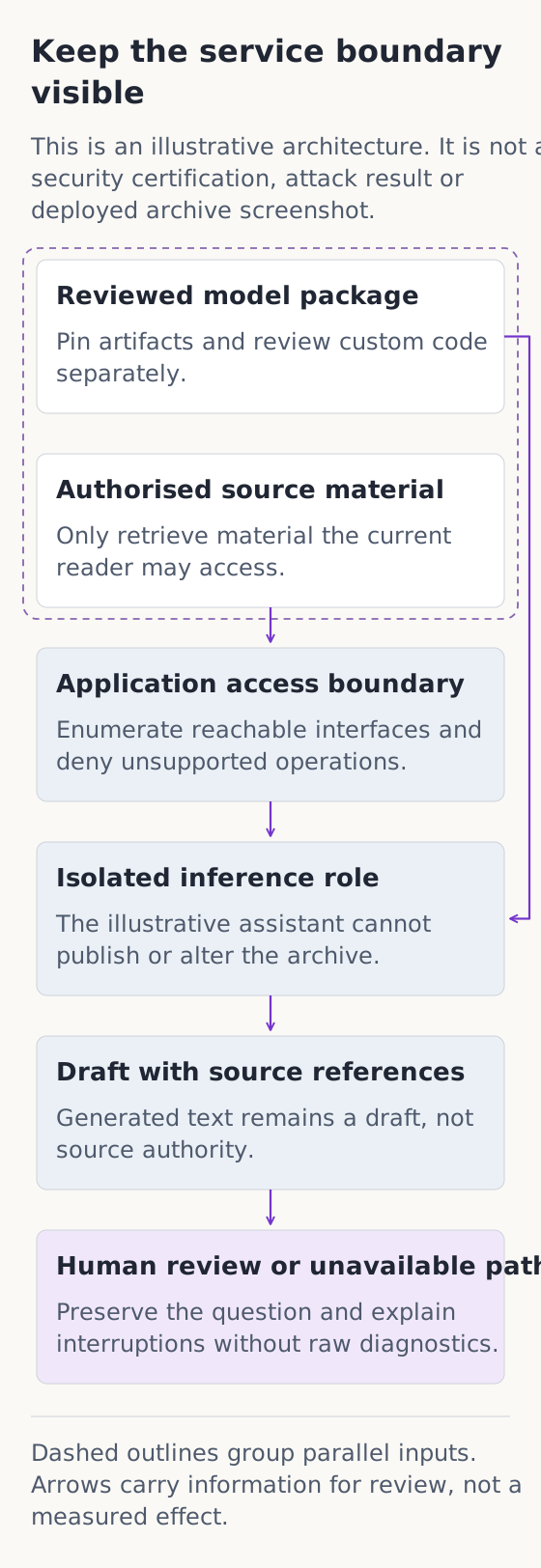
Original explanatory diagram of a fictional read-only draft service; no deployed archive or security certification is shown.
[Open the complete evidence diagram](/assets/open-source-workflow-serving-handoff-20261015.svg)
Read the diagram
**Keep the service boundary visible**
This is an illustrative architecture. It is not a security certification, attack result or deployed archive screenshot.
- **Reviewed model package.** Pin artifacts and review custom code separately.
- **Authorised source material.** Only retrieve material the current reader may access.
- **Application access boundary.** Enumerate reachable interfaces and deny unsupported operations.
- **Isolated inference role.** The illustrative assistant cannot publish or alter the archive.
- **Draft with source references.** Generated text remains a draft, not source authority.
- **Human review or unavailable path.** Preserve the question and explain interruptions without raw diagnostics.
Dashed outlines group parallel inputs. Arrows carry information for review, not a measured effect.