Singapore's legal-AI guide and LIFT programme address different parts of adoption
The final March 2026 guide, LIFT pilot design and court-user records address separate responsibilities around implementing legal technology.
Publishing principles does not automatically change how a legal team handles work. Someone still has to understand the existing process, choose a suitable tool, train the people using it and recognise when the new arrangement is failing. Singapore's legal-technology records describe both a final sector guide and practical support for that organisational work.
They also distinguish the legal professional from the person placing material before a court. Those roles can overlap, but their responsibilities should not disappear into a single AI-policy statement. The interesting development is how separate programmes address the handoffs between principles, implementation and actual use.
The March 2026 guide is the final version
The Ministry of Law's [6 March 2026 launch announcement](https://www.mlaw.gov.sg/launch-of-guide-for-using-generative-artificial-intelligence-in-the-legal-sector/) identifies the final Guide for Using Generative Artificial Intelligence in the Legal Sector. It followed consultation from 1 to 30 September 2025. The announcement organises its approach around professional ethics, confidentiality and transparency, while retaining professional judgment and responsibility for work products.
This is a final guide, not the September consultation draft. It is also not an experiment demonstrating better legal outcomes. Its discussion of implementation and practice examples should be read as guidance and reported experience, rather than a comparative accuracy or productivity result that every firm can expect.
LIFT starts with the firm's process
The separate [30 June 2025 LIFT pilot announcement](https://www.mlaw.gov.sg/driving-the-next-stage-of-digitalisation-through-lift/) describes consultants identifying process gaps, recommending solutions, helping implementation and reviewing use. It sets out an initial intensive phase of about two months followed by about five months of aftercare, with co-payment for consultancy.
The announcement expected the pilot to conclude by the third quarter of 2026. That is an expectation recorded in a dated source, not proof of completion or successful outcomes as of this article's check. LIFT is broader legal-technology adoption support; it should not be treated as a trial showing that a particular generative model improves legal work.
Court users have a separate source to consult
The Singapore Courts' [2024 guide for court users](https://www.judiciary.gov.sg/docs/default-source/circulars/2024/registrar%27s_circular_no_1_2024_supreme_court.pdf), applicable from 1 October 2024, addresses generative AI in preparing court documents. It includes lawyers and self-represented people within its scope and preserves their responsibilities for material submitted to court.
The cited historical circular is a distinct judicial record, rather than a provision created by the March 2026 Ministry guide. An [official written reply of 4 August 2026](https://www.mlaw.gov.sg/written-reply-by-minister-of-law-mr-edwin-tong-sc-on-ai-evidence-tendered-in-court/) continues to identify both guides and the responsibility for accurate, relevant, independently verified court material. Anyone involved in an actual proceeding must consult the relevant current court instructions and professional requirements. This article is not a substitute for that check or advice about a particular filing.
Principles and implementation answer different questions
| Record | Main contribution | What it does not establish | | --- | --- | --- | | Final sector guide | Principles and practice guidance for legal work | An independently measured outcome gain | | LIFT pilot design | Diagnosis, implementation and aftercare support | Confirmed completion or every firm's suitability | | Court-user guide | Responsibilities around court material | Universal permission to use every AI feature | | Exercise below | A fictional way to inspect a handoff | A validated operating model |
This original table keeps the evidence stages visible. A programme announcement, a guide and a simulated exercise are useful for different reasons. They should not be added together as though they were three independent demonstrations of model reliability.
A fictional knowledge-management exercise
Imagine an adult legal-operations training group in Singapore working with invented internal guidance about scheduling a team meeting. The material contains a current instruction, an older superseded note and an unresolved question. It is deliberately unrelated to a real client's matter or a court filing.
The group proposes an assistant that locates the relevant passage and helps prepare an internal response. Before selecting a product, trainees map who maintains the source, who decides whether it is current and who reviews the response. This is an illustrative exercise, not a report of a LIFT participant or a deployment endorsed by the Ministry.
Diagnosis can change the proposed solution
In the fictional workshop, the first idea is to add a chatbot. A closer look shows that the two conflicting documents have no clear owner. Faster generation would not resolve that problem. The team first creates a visible version relationship and an owner for deciding which instruction should be used.
This does not prove that a chatbot is unnecessary. It shows why understanding the process can change the role assigned to it. The proposed assistant now identifies the passage and its status, while an unresolved question goes to the designated person. The exercise evaluates whether that division is understandable rather than assuming that generated answers are the objective.
Aftercare has something concrete to examine
The workshop defines categories for later review: useful answer, outdated source, incomplete information, unsuitable request and processing failure. Trainees can then discuss which problems concern the model and which concern the surrounding information process. A single satisfaction score would conceal those differences.
These are original proposed categories, not measured LIFT findings or official reporting requirements. A real implementation would need appropriate evaluation and data arrangements. Even a small training exercise can make a useful distinction between people finding an interface pleasant and people obtaining the information they need reliably.
The team also records work spent maintaining and reviewing the source. A quick response may depend on careful preparation elsewhere. Without observing that preparation, it would be premature to describe the system as saving the whole team time or reducing the number of staff required.
Keep assistance separate from consequential action
A second fictional screen offers to turn the internal response into a message. The trainees distinguish a suggested draft, a reviewed draft and a confirmed transmission. They use a mock recipient and never send anything. The exercise asks whether approval has a clear meaning at each stage.
If the simulated transmission cannot be confirmed, the interface explains that status without inventing success or exposing technical diagnostics. The draft remains available. This is a proposed usability test inspired by the implementation problem; the cited sources do not establish that any particular legal product already handles the situation this way.
Training should develop judgment as well as familiarity
Knowing which button produces an answer is different from recognising when an answer rests on an old document. Adult trainees can practise the latter by comparing the assistant's response with the underlying source and explaining why they would revise or withhold it.
For professional teams, that exercise needs to fit the actual responsibilities of the people involved. A general guide cannot determine the right allocation for every practice area, organisation or matter. The fictional materials avoid real client records precisely because the training objective can be explored without creating unnecessary confidentiality or data-handling questions.
What the programmes make visible
The final guide makes professional responsibility explicit; LIFT's design acknowledges diagnosis and implementation work; the court-user record addresses material placed before a court. None establishes that adoption is complete simply because a licence has been purchased or a policy has been written.
The concrete human work includes maintaining knowledge, explaining exceptions, reviewing outputs and helping colleagues use the process. Developers can support those tasks by making sources, versions and operation status inspectable. No guaranteed cost saving, staffing reduction or legal outcome is inferred. This is general educational reporting checked on 15 October 2026, with final guidance, historical court material and a pilot's stated expectations kept distinct.
Evidence diagram and readable guide
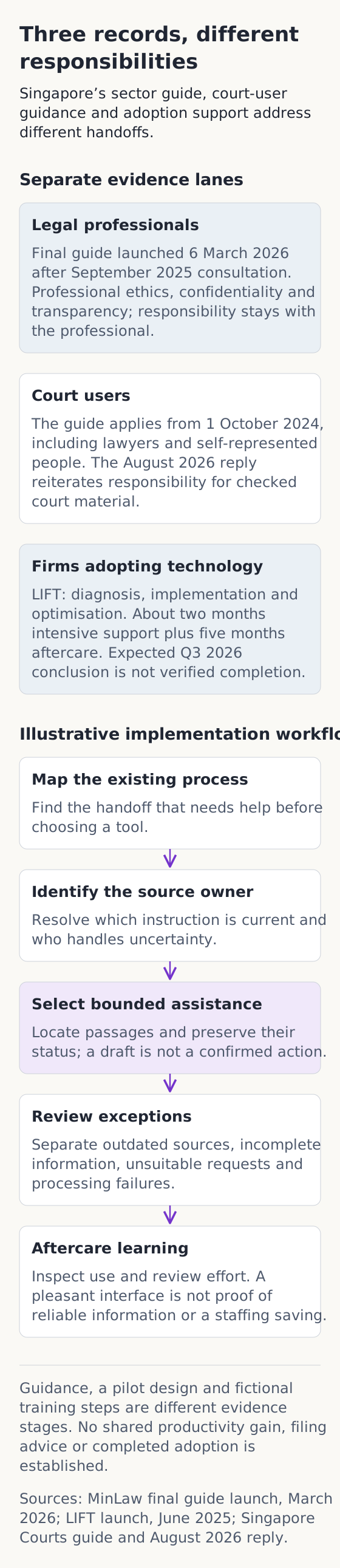
Three separate evidence lanes distinguish legal professionals, court users and firms adopting technology, followed by an illustrative implementation workflow.
[Open the complete evidence diagram](/assets/legal-workflow-singapore-adoption-20261015.svg)
Read the diagram
**Three records, different responsibilities**
Singapore’s sector guide, court-user guidance and adoption support address different handoffs.
Separate evidence lanes
- **Legal professionals.** Final guide launched 6 March 2026 after September 2025 consultation. Professional ethics, confidentiality and transparency; responsibility stays with the professional.
- **Court users.** The guide applies from 1 October 2024, including lawyers and self-represented people. The August 2026 reply reiterates responsibility for checked court material.
- **Firms adopting technology.** LIFT: diagnosis, implementation and optimisation. About two months intensive support plus five months aftercare. Expected Q3 2026 conclusion is not verified completion.
Illustrative implementation workflow
- **Map the existing process.** Find the handoff that needs help before choosing a tool.
- **Identify the source owner.** Resolve which instruction is current and who handles uncertainty.
- **Select bounded assistance.** Locate passages and preserve their status; a draft is not a confirmed action.
- **Review exceptions.** Separate outdated sources, incomplete information, unsuitable requests and processing failures.
- **Aftercare learning.** Inspect use and review effort. A pleasant interface is not proof of reliable information or a staffing saving.
**Reading the evidence.** Guidance, a pilot design and fictional training steps are different evidence stages. No shared productivity gain, filing advice or completed adoption is established.
*Sources: MinLaw final guide launch, March 2026; LIFT launch, June 2025; Singapore Courts guide and August 2026 reply.*
**Keep the comparisons separate.** Distinct roles and programmes; no combined effect or automatic completion inference.