TB screening AI now has a clearer evidence base—and a bigger delivery challenge
WHO’s 2025 CAD update and a South African image study sharpen the evidence for TB screening while highlighting confirmation, age limits and service continuity.
A portable X-ray unit can bring screening closer to a community, but an image alone does not complete tuberculosis care. Someone must explain the result, arrange the next test and make sure the person can reach the appropriate service. AI can help interpret a large flow of images while leaving these practical links unresolved.
In June 2025, the World Health Organization announced that six computer-aided detection products met its performance standards for screening people aged 15 and older. Research published the following month compared a wider set of products with radiologists reading South African survey images. Together these records make a substantial story about a defined public-health task, with clear limits on age, diagnosis and generalisation.
What the WHO announcement actually covers
The [WHO departmental update of 11 June 2025](https://www.who.int/news/item/11-06-2025-who-approves-six-software-products-for-computer-aided-detection-of-tb-on-chest-x-ray) concerns computer-aided detection, or CAD, on chest X-rays during TB screening. It describes an independent assessment involving FIND and WHO's technical advisory group, following a manufacturer call in 2024.
The age boundary is explicit: people aged 15 years and older. WHO says it does not yet recommend CAD screening for younger children and adolescents in this context. It also says a positive screen requires confirmatory testing before treatment. These are consequential boundaries; the announcement is not a licence to turn an abnormality score into an automatic diagnosis.
A policy record is different from a product contest
The accompanying [WHO policy statement](https://www.who.int/publications/i/item/9789240110373), dated 10 June 2025, explains the update in the context of CAD recommendations dating from 2021. The release and statement belong to one WHO policy programme, not two independent trials. They concern the specified screening use, rather than ranking every available chest-imaging system.
This article does not recommend a particular vendor. Products and versions evaluated in a study may differ from what an organisation can buy now. Nor does a WHO statement substitute for local implementation arrangements, equipment availability or the process connecting screening to confirmation.
South African images, radiologists from four countries
The [Qin and colleagues study](https://www.nature.com/articles/s41598-025-06164-w), published in Scientific Reports on 2 July 2025, compared 12 CAD products and 11 radiologists from Nigeria, India, the United Kingdom and the United States. The images came from 774 participants in the South African National TB Prevalence Survey. The evaluation used a composite microbiological reference standard.
The international element concerns the readers, not four national patient samples. Performance varied, and the dataset contained 258 TB cases among the 774 selected participants. Its case-enriched evaluation should not be treated as the prevalence of TB in South Africa or a prediction of how many people would screen positive in a new community programme.
The evidence has several different boundaries
| Record | What was evaluated | What it does not establish | | --- | --- | --- | | WHO June 2025 update | Six products against specified screening standards | Diagnostic confirmation from an image alone | | WHO policy statement | Updated assessment and recommendation context | Independent local delivery success | | July 2025 comparison | 774 selected South African participants; 12 CAD products | A new worldwide population survey | | Fictional delivery exercise below | Referral and information continuity | Observed patient benefit |
The source survey ran from August 2017 to July 2019. The study also reused CAD readings from a related evaluation. Two papers using those same images and predictions are not two new patient cohorts. Manufacturer outreach ran between January 2021 and December 2023; the 2025 publication date is not the date of every underlying observation.
Why threshold choice changes the workload
A screening programme needs to decide how an output leads to the next step. A lower threshold can send more people for confirmation, including people who do not have TB. A higher threshold can reduce referrals while missing more cases. The useful balance depends on the intended population and the rest of the pathway.
That is a reasoning consequence of screening, not a proposed threshold or medical instruction. Programme specialists should establish the operational choice from the appropriate evidence and requirements. A single area-under-the-curve score cannot tell a clinic whether its laboratory, transport and follow-up arrangements can support the resulting referrals.
An illustrative community-service exercise
Imagine a fictional district team in South Africa rehearsing a screening-day workflow with invented records. This is an educational scenario, not a reported deployment of a named CAD product. The team uses mock results to test whether every person receives an understandable next-step explanation and whether outstanding follow-up can be found later.
One invented record needs image-quality review. Another has a screening result requiring further assessment. A third cannot be processed because the software is unavailable. These should produce different messages. The unavailable analysis must not be recorded as a reassuring result, and a repeat visit should not create an unlinked second identity.
Language and continuity belong in the design
In the fictional rehearsal, staff prepare approved messages in the languages the service supports, then ask community reviewers to explain those messages back in their own words. This is a proposed usability exercise. Neither the WHO update nor the image-comparison study establishes that a particular multilingual interface improves outcomes.
The team checks whether people understand that screening is preliminary and know the next contact or location. It avoids displaying a raw score without context. If an appointment or transport arrangement is not confirmed, the interface says so. A helpful system should not imply that care has been arranged merely because it printed a referral.
Connectivity also deserves an honest state. Work awaiting synchronisation should remain distinguishable from work accepted by the receiving service. A staff member needs a safe way to find unresolved cases without publishing private health information on a shared dashboard.
Measure the route after the image
An implementation evaluation should count more than X-rays processed per hour. Relevant questions include how many analyses fail, how long people wait for confirmation and where follow-up is lost. Measures should retain their denominators: people screened, people referred and people completing confirmation are different groups.
Separately examine image quality and the populations included in validation. A strong overall result cannot establish performance for an unevaluated age group or setting. The South African comparison gives a concrete reason to inspect population characteristics and prior clinical context rather than assume all abnormality scores travel unchanged between programmes.
These are proposed evaluation questions. This reporting did not operate a CAD system, access patient data or independently reproduce the study's results. It also makes no claim about current per-screen costs, staffing savings or the number of cases a future programme would detect.
What workers and students can learn
Radiographers, laboratory teams, community workers and software developers each own a different link. Faster interpretation may shift work towards explanation, confirmation and tracking rather than simply remove it. The cited records do not provide a basis for forecasting layoffs or substituting a screening system for the whole service.
A student can build a fictional pathway map and deliberately insert a failed upload, an unreadable image and an unconfirmed referral. The exercise is successful when the interface preserves the case and explains a safe next action without pretending a result exists.
The next evidence worth watching connects screening accuracy with completed care in clearly described local programmes. This article is educational, non-promotional public-health reporting, not personal medical advice. Sources were checked on 15 October 2026. The invention's value depends on both interpreting the image and carrying its uncertainty responsibly to the next step.
Research pathway and readable guide
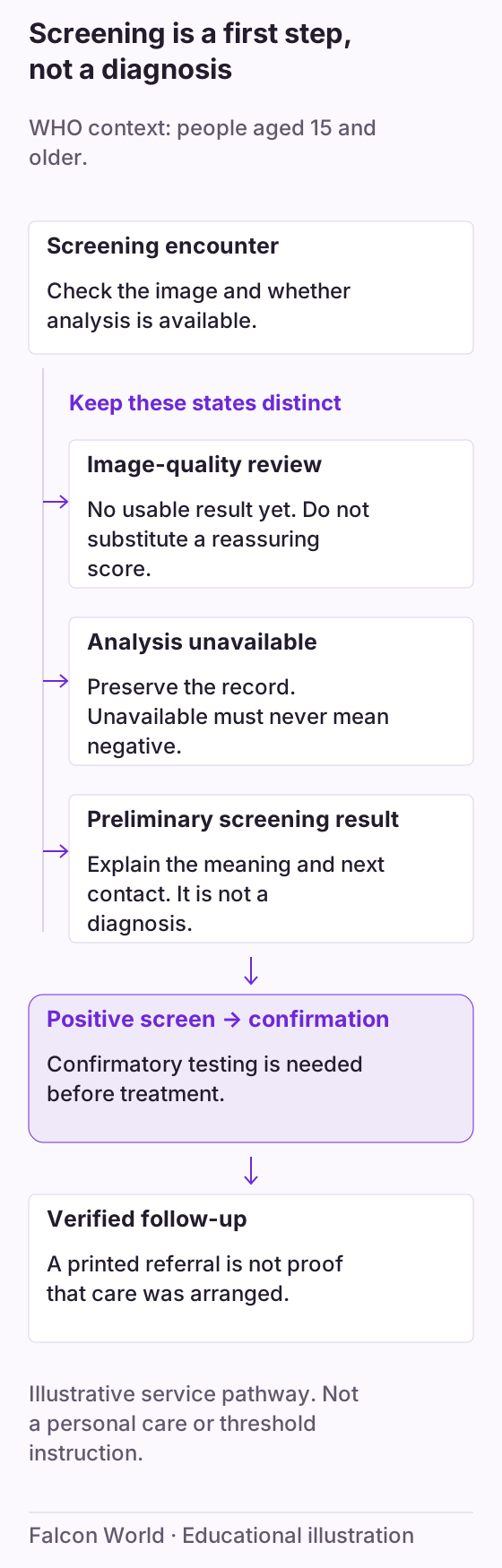
Original educational diagram of research boundaries and a fictional example. Not personal medical advice, a treatment instruction, regulatory approval or an actual clinical deployment.
[Open the complete research diagram](/assets/healthcare-workflow-tb-screening-20261015.svg)
Read the diagram
**Screening is a first step, not a diagnosis**
WHO context: people aged 15 and older.
- **Screening encounter.** Check the image and whether analysis is available.
**Keep these states distinct**
- **Image-quality review.** No usable result yet. Do not substitute a reassuring score.
- **Analysis unavailable.** Preserve the record. Unavailable must never mean negative.
- **Preliminary screening result.** Explain the meaning and next contact. It is not a diagnosis.
- **Positive screen → confirmation.** Confirmatory testing is needed before treatment.
- **Verified follow-up.** A printed referral is not proof that care was arranged. Illustrative service pathway. Not a personal care or threshold instruction.
*Falcon World · Educational illustration*
These pathways describe different research tasks and evidence boundaries. An arrow does not establish that one study caused another or that a research finding leads automatically to clinical benefit.