Teaching with AI starts with a decision about saved planning time
An English science-planning trial offers a bounded workload result. Schools elsewhere still need to protect professional judgment, local adaptation and the purpose of released time.
A teacher's planning time is not an empty space waiting to be filled with more lessons. It includes deciding what pupils need, choosing examples, adapting materials and anticipating misunderstandings. Generative AI can help produce resources, but schools still have to decide which parts of that work should remain professional learning and which can be simplified. The employment question is therefore broader than how quickly a worksheet appears. It concerns workload, shared preparation, teaching expertise and the time available to notice when a resource does not fit a class.
An [Education Endowment Foundation trial reported on 12 December 2024](https://educationendowmentfoundation.org.uk/news/teachers-using-chatGPT-alongside-a-guide-to-support-them-to-use-it-effectively-can-cut-lesson-planning-time-by-over-30-per-cent) involved 259 teachers in 68 English secondary schools. Teachers allocated ChatGPT with implementation guidance spent 31% less time on the measured Year 7 and 8 science planning and resource tasks: 56.2 minutes weekly versus 81.5 minutes in the comparison group. A limited sample of materials showed no noticeable quality difference. This was a supported, subject-specific preparation trial, not evidence that whole teaching jobs can be reduced by 31% or that pupil attainment improved.
That difference in denominator should shape any staffing conversation. Planning one activity in a lesson is not the same as supervising learning, responding to a disclosure, discussing progress with a family or coordinating support with colleagues. A school can use a measured reduction in preparation effort to ask what it wants teachers to do with released time. It should not silently treat that time as spare capacity before checking whether review, adaptation and classroom follow-up have changed. Any proposal to increase workload requires its own evidence and discussion.
Consider an explicitly fictional group of science teachers in Chennai preparing a lesson about electrical circuits. In an adult staff workshop, they ask an approved assistant to suggest explanations and questions using invented pupil responses. One generated activity assumes equipment their school does not have; another question rewards memorising a definition without testing the intended understanding. The teachers replace those elements and explain why. This is an illustrative preparation exercise, not a deployment at a named school, an instructional safety procedure or a measured learning result.
The exercise creates a concrete professional skill: evaluating whether a resource serves a learning purpose under local conditions. A teacher might retain a useful analogy while changing the language level and checking every scientific statement against an approved reference. A colleague can review whether an assessment question would reveal the intended misconception. The team should keep the rationale for those choices, so that a less experienced teacher can learn from the work. A folder of polished worksheets is less valuable than a reusable account of why particular choices fit.
A school could therefore fund collaborative review rather than requiring every teacher to become an isolated prompt specialist. A subject lead might curate approved examples, a classroom teacher might test whether instructions are understandable, and a learning-support colleague might identify accessibility problems. Those are proposed responsibilities, not jobs proved necessary by the trial. The arrangement should respect existing professional roles and avoid shifting hidden checking work onto assistants or early-career teachers. The time allocated to review should appear in the implementation plan and workload discussion.
The [UNESCO guidance first published on 7 September 2023](https://www.unesco.org/en/articles/guidance-generative-ai-education-and-research), whose page records an update on 16 January 2026, places human agency, privacy and age-appropriate use at the centre of educational adoption. Guidance is not a classroom effectiveness experiment. It nevertheless highlights why a staff preparation tool and a pupil-facing chatbot need separate decisions. A school should not infer permission to upload identifiable pupil information, or to invite independent use by children, simply because an adult teacher found resource drafting helpful.
Preserving expertise also means keeping some practice independent of the assistant. [Microsoft Research's CHI 2025 survey](https://www.microsoft.com/en-us/research/publication/the-impact-of-generative-ai-on-critical-thinking-self-reported-reductions-in-cognitive-effort-and-confidence-effects-from-a-survey-of-knowledge-workers/) collected self-reports from 319 knowledge workers. Greater confidence in AI was associated with less reported critical-thinking effort; the study did not establish a causal loss of skill or measure teachers specifically. For a school, a reasonable design response is to ask staff to explain and sometimes construct an assessment themselves. That is an editorial recommendation, not a finding that this research tested the proposed teaching practice.
Evaluation can separate three questions. Did preparation take less total time after checking and adaptation? Were the resulting resources suitable for the planned lesson? What happened when teachers used them? The third question needs classroom evidence and appropriate educational safeguards; a staff satisfaction form cannot answer it. Schools should also look for uneven effects. An experienced subject teacher may recognise a subtle error that a newcomer misses, while a newcomer may benefit from a useful initial structure. Neither should be judged only on the speed of generating material.
International comparisons require the same caution. Findings from supported science planning in England do not establish an effect for every subject, curriculum or language. The fictional Chennai team would need to check local syllabus expectations, available materials and the language in which pupils learn. A resource that reads well in English may still fail to express the intended idea clearly in another language. Employers should include teachers who work under different conditions in the review, rather than allowing the most connected classroom to stand in for the whole system.
Teachers can ask for approved tools, protected preparation time and a clear explanation of how their work will be assessed. School leaders can state whether the aim is reduced after-hours workload, more individual feedback or better shared resources, and then measure that aim. They should retain a usable non-AI route and avoid treating refusal of a poor suggestion as resistance to innovation. A sensible rollout gives professional judgment somewhere to operate. Saving preparation time matters most when the school has made a deliberate, reviewable choice about what that time is for.
Evidence diagram and readable guide
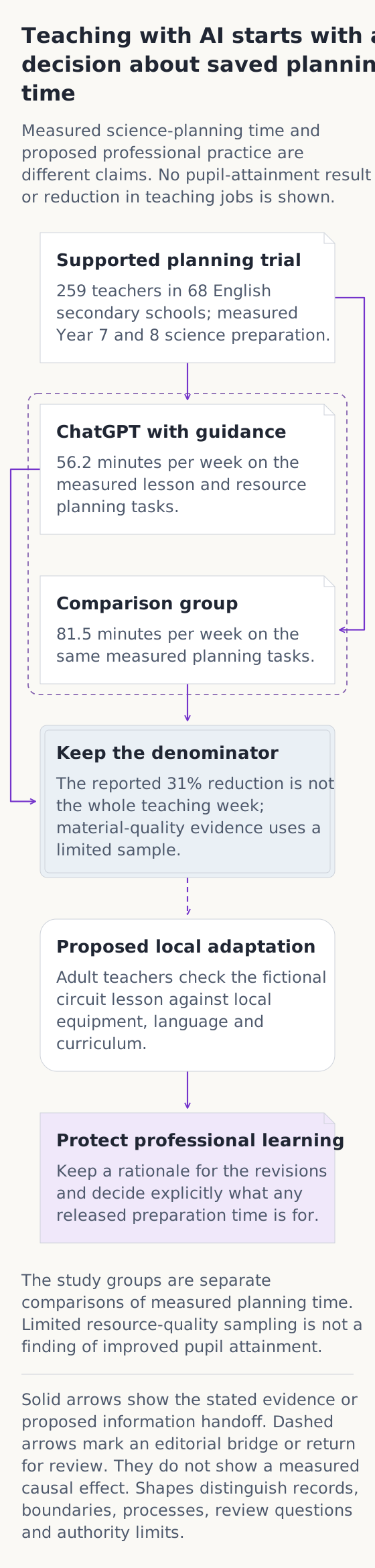
Original explanatory infographic: Measured science-planning time and proposed professional practice are different claims. No pupil-attainment result or reduction in teaching jobs is shown.
[Open the complete evidence diagram](/assets/future-work-workflow-education-planning-time-20261016.svg)
Read the diagram
**Teaching with AI starts with a decision about saved planning time**
Measured science-planning time and proposed professional practice are different claims. No pupil-attainment result or reduction in teaching jobs is shown.
- **Supported planning trial** 259 teachers in 68 English secondary schools; measured Year 7 and 8 science preparation.
- **ChatGPT with guidance** 56.2 minutes per week on the measured lesson and resource planning tasks.
- **Comparison group** 81.5 minutes per week on the same measured planning tasks.
- **Keep the denominator** The reported 31% reduction is not the whole teaching week; material-quality evidence uses a limited sample.
- **Proposed local adaptation** Adult teachers check the fictional circuit lesson against local equipment, language and curriculum.
- **Protect professional learning** Keep a rationale for the revisions and decide explicitly what any released preparation time is for.
The study groups are separate comparisons of measured planning time. Limited resource-quality sampling is not a finding of improved pupil attainment.
How the connections work
- The trial context defines the assisted group and measured planning task.
- The same context defines the separate comparison group.
- The assisted time measure retains its task-specific scope.
- The comparison time belongs to the same planning measure, not the whole job.
- The evidence boundary frames a proposed local adaptation exercise, not a learning-outcome claim.
- The proposed revisions and their rationale support a professional-learning discussion.
Relationship key
Solid arrows show the stated evidence or proposed information handoff. Dashed arrows mark an editorial bridge or return for review. They do not show a measured causal effect. Shapes distinguish records, boundaries, processes, review questions and authority limits.
Diagram references
- [Teachers using ChatGPT alongside a guide can cut lesson planning time](https://educationendowmentfoundation.org.uk/news/teachers-using-chatGPT-alongside-a-guide-to-support-them-to-use-it-effectively-can-cut-lesson-planning-time-by-over-30-per-cent)
- [Guidance for generative AI in education and research](https://www.unesco.org/en/articles/guidance-generative-ai-education-and-research)
- [The Impact of Generative AI on Critical Thinking](https://www.microsoft.com/en-us/research/publication/the-impact-of-generative-ai-on-critical-thinking-self-reported-reductions-in-cognitive-effort-and-confidence-effects-from-a-survey-of-knowledge-workers/)