The AI explanation felt helpful. Three days later, the notes mattered
A 405-pupil reading experiment and a small MIT essay preprint distinguish convenient explanations, learner ownership and later recall without claims of brain damage.
Reading an explanation and being able to reconstruct it later are different achievements. An assistant can make a difficult paragraph feel manageable while doing some of the organising the reader would otherwise have to do. Recent research gives this familiar concern a more precise experimental form.
A study of secondary-school readers in England compared language-model assistance, note-taking and a combination. Separately, an MIT essay-writing preprint examined ownership, recall and neural measurements under different tool conditions. The strongest lesson is about the activity being outsourced, rather than a sweeping claim that AI damages a brain or makes every learner less capable.
The reading experiment included a delayed check
The [Kreijkes and colleagues paper](https://researchdmr.com/files/LLM_Notes_Reading_Comp.pdf), available online on 24 November 2025 and assigned to a 2026 Computers & Education volume, recruited 405 students aged 14–15 from seven English secondary schools. Its main study ran from March to July 2024. After exclusions, 344 students were retained for analysis.
Participants studied two passages and completed comprehension and retention tests three days later. Note-taking alone and note-taking combined with LLM use performed better than LLM use alone on those outcomes. Three days is the actual interval; the study does not establish what would remain a year later.
Preference and learning did not tell the same story
Many pupils preferred the LLM and considered it more helpful. That is an important usability result, but it did not make the preferred condition the strongest learning condition in this experiment. A tool can reduce the immediate difficulty of a task without maximising what someone retains.
The researchers did not include a reading-only control. Their comparisons therefore do not establish that every kind of AI-assisted reading is worse than reading unaided. This boundary matters when turning an experimental result into advice: the tested alternatives were particular learning activities, not every possible way to read.
MIT examined a different writing task
The [MIT-associated essay-writing preprint](https://arxiv.org/abs/2506.08872) was first submitted on 10 June 2025 and revised on 31 December 2025. It reports 54 participants in the first three sessions and 18 completing a fourth session that changed tool conditions. Participants wrote with an LLM, a search engine or neither.
The study combines EEG, text analysis and interviews, including recall and reported ownership of the essays. It remains a preprint in the retained record. Its small, task-specific sample cannot establish a universal effect on intelligence, diagnose damage or demonstrate what happens to children across years of schooling.
A project explanation is not a second experiment
The [MIT Media Lab project page](https://www.media.mit.edu/projects/your-brain-on-chatgpt/overview/) describes the same participant groups and the difficulty LLM users had quoting their own essays shortly after writing. It provides context from the research team, not independent confirmation of the preprint.
The neural measurements also require restraint. A difference in connectivity during a task is not a general score of how much someone is thinking. The reading experiment and essay experiment investigate different activities, populations and outcomes. They should not be combined into a claim that one biological mechanism has been demonstrated across all learning.
Keep the evidence units visible
| Record | Actual learning activity | Important boundary | | --- | --- | --- | | English school experiment | Reading two passages with different study methods | 405 recruited; 344 analysed; three-day tests | | MIT essay preprint | Writing under three tool conditions | 54 initial participants; 18 in crossover session | | MIT project page | Researchers' account of that essay work | Same programme, not replication | | Exercise below | Fictional preparation and recall | No measured attainment effect |
The table is an original guide to interpreting the records. It does not equate reading comprehension, quoting an essay, ownership and neural activity as interchangeable measures of learning.
An illustrative reading session
Imagine a fictional adult evening class in Leeds studying a short, licensed passage about urban water systems. This is an educational example, not a replication of the school experiment. Learners first identify an explanation they find difficult, then make a brief note describing the relationship in their own words.
An approved assistant can offer another explanation, but the learner keeps the original passage visible and records what changed in their understanding. The exercise distinguishes copied output from the learner's own account. It uses invented responses for demonstration and does not collect children's work.
Make a note that does intellectual work
A note is not automatically useful because someone typed it. The fictional teacher asks for a causal link, an example or an unresolved question rather than a paragraph copied from the assistant. A learner might write that a change in one part of the system affects another, then identify the sentence supporting that explanation.
Next, the teacher introduces a plausible but incorrect AI explanation. Learners compare it with the passage and revise the note if needed. This proposed activity tests inspection and reconstruction. It does not establish that adding one particular note-taking rule reproduces the published result.
At a later class meeting, the teacher can discuss which relationships learners can explain without consulting their notes. That is a teaching exercise, not an informal diagnosis of memory problems. Differences may reflect prior knowledge, language or the way the question is phrased, and need careful interpretation.
Avoid turning uncertainty into a personal label
Difficulty recalling a passage does not prove that a learner is lazy or dependent on AI. Nor does confidence prove mastery. A supportive discussion asks which part of the material remains unclear and which study action could make it easier to explain.
For learners using accessibility support, removing a tool can change the task in ways unrelated to the intended learning objective. A teacher should distinguish the skill being assessed from an accommodation that makes participation possible. The cited studies do not settle the right arrangement for every learner or disability.
For participants under 18, schools need the appropriate approved tools, safeguarding and data arrangements before any real exercise. This article offers no universal legal-compliance rule. A teacher-training demonstration can use fictional examples while exploring the instructional design.
What developers should make distinguishable
A study interface can separate the source passage, the assistant's explanation and the learner's note. Clear labels help prevent generated text from quietly becoming evidence of the learner's own understanding. The system should preserve a note when generation fails and explain that assistance is unavailable.
Developers can also avoid treating time saved or output length as a learning score. An interaction log shows what happened on screen, not everything the learner understood. Meaningful evaluation needs an independently defined outcome and a clearly described delay between study and assessment.
A stronger research question than whether AI is good or bad
Ask which learning action an assistant supports, which action it removes and what remains after the session. Studies that compare different combinations of reading, questioning and note-making can answer that more precisely than broad claims about screen time or brain engagement.
Teachers and students can use these distinctions without adopting a new platform. The research creates work in designing prompts, tasks and checks that reveal understanding; it does not establish inevitable job losses or guaranteed grade changes. This is educational, non-promotional reporting checked on 15 October 2026. The practical goal is to keep a helpful explanation connected to learning the reader can later use.
Evidence diagram and readable guide
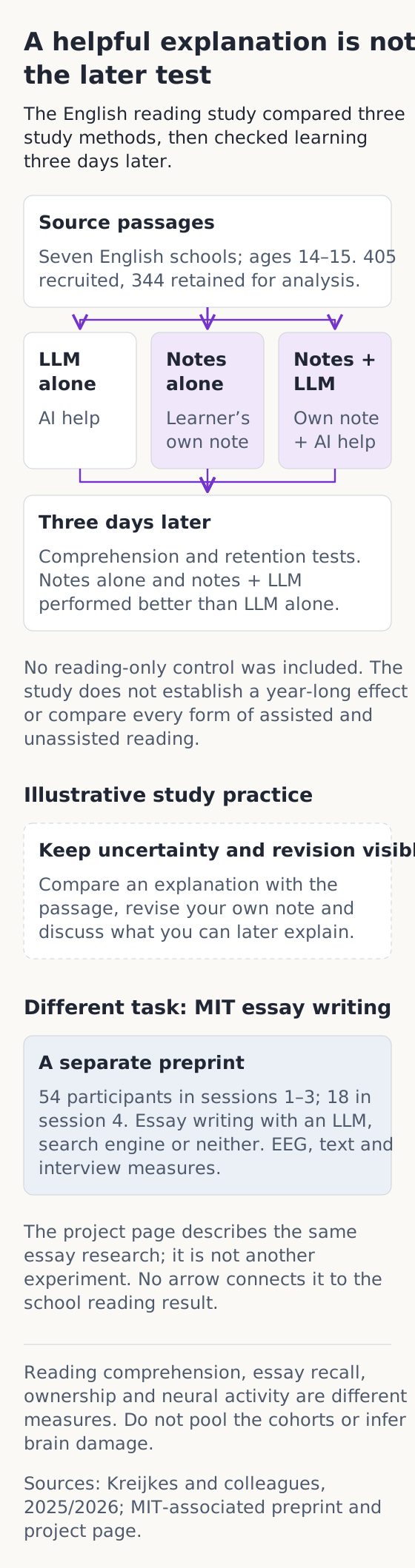
The reading-study map preserves its three methods and three-day assessment, with the MIT essay preprint shown separately.
[Open the complete evidence diagram](/assets/education-workflow-reading-memory-20261015.svg)
Read the diagram
**A helpful explanation is not the later test**
The English reading study compared three study methods, then checked learning three days later.
- **Source passages.** Seven English schools; ages 14–15. 405 recruited, 344 retained for analysis.
- **LLM alone.** AI help
- **Notes alone.** Learner’s own note
- **Notes + LLM.** Own note + AI help
- **Three days later.** Comprehension and retention tests. Notes alone and notes + LLM performed better than LLM alone.
No reading-only control was included. The study does not establish a year-long effect or compare every form of assisted and unassisted reading.
Illustrative study practice
- **Keep uncertainty and revision visible.** Compare an explanation with the passage, revise your own note and discuss what you can later explain.
Different task: MIT essay writing
- **A separate preprint.** 54 participants in sessions 1–3; 18 in session 4. Essay writing with an LLM, search engine or neither. EEG, text and interview measures.
The project page describes the same essay research; it is not another experiment. No arrow connects it to the school reading result.
**Reading the evidence.** Reading comprehension, essay recall, ownership and neural activity are different measures. Do not pool the cohorts or infer brain damage.
*Sources: Kreijkes and colleagues, 2025/2026; MIT-associated preprint and project page.*
**Keep the comparisons separate.** Three study methods in the same English reading study.