The classical decoding problem inside a neutral-atom quantum experiment
A neutral-atom architecture experiment shows why classical decoding, loss information and the definition of a comparison belong beside the quantum hardware.
A Harvard- and MIT-linked team demonstrated a neutral-atom architecture combining encoded operations, repeated measurements and decoding, published online on 10 November 2025. Machine learning helps interpret the experimental records. This is an architecture experiment, not a commercially ready quantum service. [Author manuscript](https://arxiv.org/html/2506.20661v1).
The apparatus uses up to 448 physical atoms, which must not be relabelled as logical qubits. A larger code reduced error per round in a specified repeated-measurement comparison. That does not establish the same advantage for every algorithm or noise condition. [Experimental scope](https://arxiv.org/html/2506.20661v1).
The publication history deserves attention. The author preprint was submitted on 25 June 2025, ahead of the November online article; the journal issue is dated January 2026. A correction published on 19 January 2026 addresses a figure label concerning correlated decoding. It is not a withdrawal of the experiment or a newly reported change to the atom count. [Final article record](https://www.nature.com/articles/s41586-025-09848-5), [label correction](https://www.nature.com/articles/s41586-026-10108-3).
Why the decoder belongs in the scientific result
The study uses loss information in decoding, learning relationships between measurement records and likely errors. A missing atom and a measured state require different treatment. The architecture and its classical interpretation belong together; ignoring either leaves the account incomplete. [Decoding in the experiment](https://arxiv.org/html/2506.20661v1).
For a reader unfamiliar with quantum computing, it helps to ask a modest question: what record reaches the decoder? Do not begin by imagining a model reading a hidden quantum state directly. A useful explanation identifies the observations, the proposed correction and the experiment used to assess whether that interpretation improved the encoded computation.
Earlier work from the neutral-atom collaboration described logical processing with reconfigurable arrays. Its public manuscript explains encoding information across physical qubits and examining operations at the logical level. That research lineage helps explain why an atom count is not an application-performance score. The earlier processor and the newer fault-tolerant architecture remain separate experimental reports. [Earlier logical processor](https://arxiv.org/abs/2312.03982).
This also changes what a useful comparison table should contain. A proposed table would identify the encoding, measurement sequence, retained trials and error measure before listing a headline size. When these fields differ, a larger apparatus cannot automatically be treated as the better system for a reader's hypothetical task. The comparison needs a common scientific question, not just a common unit.
Machine-learning decoders do not transfer automatically
A separate Nature paper published on 20 November 2024 reports AlphaQubit, a learned decoder evaluated using superconducting-processor data and additional simulated settings. Its experimental and simulated results have different scopes. This is relevant methodological research, but it is not the neutral-atom experiment's decoder, and its larger simulated cases are not measurements on a neutral-atom machine. [Learned-decoder study](https://www.nature.com/articles/s41586-024-08148-8).
That paper also identifies practical challenges for future decoding. Accuracy and execution requirements need attention together. A proposed evaluation should therefore ask both whether a decoder identifies errors well on held-out records and whether its decision arrives within the intended operating constraints. A favourable offline comparison alone does not establish that a complete real-time system is ready. [Decoder limitations](https://www.nature.com/articles/s41586-024-08148-8).
These studies give research engineers a concrete interface to examine: experimental records in, a proposed interpretation out, followed by an independently defined assessment. Keep the measurement representation and the training conditions explicit. A system trained for one arrangement should not acquire authority over a different arrangement merely because both are called quantum error correction.
The January correction offers a small but useful lesson in reading carefully. A changed figure label can affect what a reader thinks is being compared without implying that the entire result disappeared. Notes about a paper should retain the corrected interpretation and identify the version examined. Treating every correction as either meaningless or catastrophic would miss its actual content. [Correction notice](https://www.nature.com/articles/s41586-026-10108-3).
A fictional exercise about missing observations
Consider an invented classroom model with cards representing recorded checks. Some cards show a synthetic observed value and others explicitly say missing. Students are given a deliberately simplified lookup rule for proposing an error explanation. This is an analogy for information handling, not a quantum simulation, and it has not been run as an experiment.
One group preserves the missing marker. Another replaces it with an ordinary observed value. The worked conclusion is that unknown and observed are different records: the replacement claims a measurement that never happened. Before consulting an answer key, both groups identify that lost distinction. The outcome concerns representation, not an estimate of a real processor's error rate.
Now introduce a second fictional recording format whose check order differs. Students must decide whether their original lookup rule still has the same meaning. They may discover that a familiar-looking row needs translation before it can be interpreted. They should document that mismatch instead of reporting a model failure or success against incompatible inputs.
The instructor can then ask for a proposed comparison plan. Which records would be kept apart from rule development? What would count as a wrong interpretation? What happens when the system declines to decide? These questions make the exercise useful without suggesting that a few classroom cards implement a quantum code or reproduce either Nature paper.
Practical progress includes the surrounding system
The earlier neutral-atom processor report gives a physical and logical context for the newer work, but its demonstrations should not be added to the later article as though all operations happened in one identical run. A research chronology is valuable precisely because architectures, encodings and experimental goals evolve. [Prior processor report](https://arxiv.org/abs/2312.03982).
For a prospective student project, a sensible first deliverable is a versioned reading map: apparatus, encoding, recorded checks, decoder and assessment. A second deliverable might compare the definitions used by different papers. Neither requires a claim to have accessed quantum hardware. This publication has not trained a decoder, operated the apparatus or independently reproduced the reported performance.
An appropriate visual would show a fictional researcher examining clearly schematic atom positions and a separate classical decoding panel. It should not fabricate an authentic laboratory screenshot or imply that an illustrated array belongs to Harvard, MIT or another named institution. The image can communicate the interface without pretending to document an experiment that did not occur.
The interesting development is the connection between physical error-correction experiments and the classical systems needed to interpret them. Machine learning is one part of that connection. Understanding what was measured, what was decoded and what remains experimentally constrained gives readers a practical route into the research without turning an architecture demonstration into a promise about applications.
Conceptual diagram and reading companion
Original conceptual illustration and unperformed classroom exercise; no measured data, authentic research interface or reproduced result is shown.
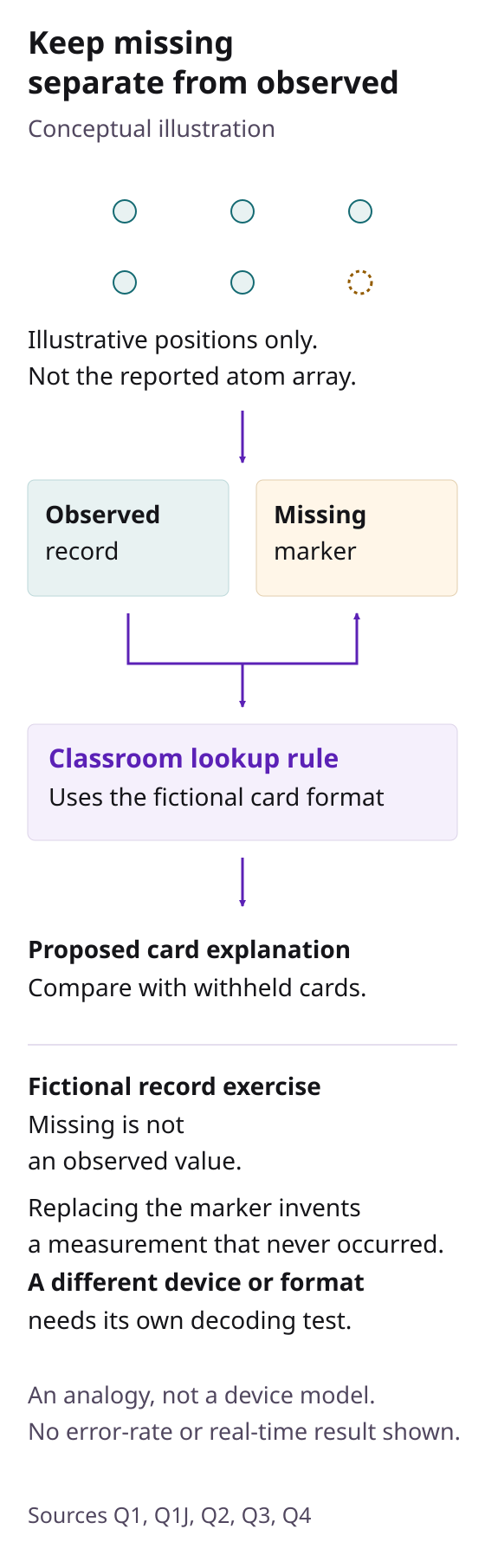
Original conceptual illustration supporting this article. Shapes and teaching examples are explanatory, not measured data, an authentic laboratory interface or an independent reproduction. Read the accompanying source-linked guide.
[Open the complete diagram](/assets/science-quantum-record-decoding-concept-20261016.svg)
Keep missing separate from observed
An invented card-handling analogy, not a quantum simulation, apparatus record or decoder benchmark.
Do not turn a missing classroom card into an observation
For the fictional worksheet, keep an observed card and an explicitly missing card as different inputs. Ask what information would be invented by replacing the missing marker with an ordinary value. Record that distinction before consulting the imagined answer key; no output is computed in this companion.
The middle box is a proposed rule applied to the stated record format. Its outgoing arrow carries an explanation to a separate assessment, not a success badge. Retain which cards would be kept apart from rule development. The few circles are explanatory positions, not a counted replica of any apparatus.
Now change the order of the fictional checks and ask whether the original rule still means the same thing. Keep both formats and the unresolved translation. The article's unchanged reporting distinguishes the actual experiments; this exercise adds no physical/logical count, correction rate, latency result or operating service.
Readable figure labels
- Keep missing - separate from observed - Conceptual illustration - Illustrative positions only. - Not the reported atom array. - Observed - record - Missing - marker - Classroom lookup rule - Uses the fictional card format - Proposed card explanation - Compare with withheld cards. - Fictional record exercise - Missing is not - an observed value. - Replacing the marker invents - a measurement that never occurred. - A different device or format - needs its own decoding test. - An analogy, not a device model. - No error-rate or real-time result shown. - Sources Q1, Q1J, Q2, Q3, Q4
Source context
For the reported facts, dates and access limitations, read the unchanged article above. These are the same underlying references, not additional experiments. The fictional exercise and diagram do not establish a measured result.
- [Q1](https://arxiv.org/html/2506.20661v1) - [Q1J](https://www.nature.com/articles/s41586-025-09848-5) - [Q2](https://www.nature.com/articles/s41586-026-10108-3) - [Q3](https://www.nature.com/articles/s41586-024-08148-8) - [Q4](https://arxiv.org/abs/2312.03982)