The FTC's DoNotPay order makes the robot-lawyer claim an evidence question
The DoNotPay settlement and a federal court guide distinguish evidence for a service promise from a convincing generated document.
A person buying help with a dispute is buying more than well-formed sentences. They may be relying on someone to recognise an exception, ask about a missing fact or explain when the proposed action is unsuitable. Calling a subscription a substitute for a lawyer therefore makes a much larger promise than saying it can produce a letter.
The US Federal Trade Commission's action against DoNotPay makes that distinction concrete. Alongside a federal court's guidance for people representing themselves, it shows why legal-service design needs an honest description of the help being offered. The important question is which capability has actually been established, for whose task, under whose responsibility.
A final order, rather than an unresolved proposal
The [FTC's finalisation announcement](https://www.ftc.gov/news-events/news/press-releases/2025/02/ftc-finalizes-order-donotpay-prohibits-deceptive-ai-lawyer-claims-imposes-monetary-relief-requires) describes an order finalised in January 2025 following charges announced in September 2024. According to the complaint, DoNotPay had not tested whether its service operated at a human lawyer's level or retained attorneys to evaluate the quality and accuracy of its law-related features.
The announcement says the order requires $193,000 in monetary relief and notice to subscribers from 2021 to 2023. A required payment is not proof that money was paid or distributed to particular consumers. Nor is this a new October 2026 enforcement decision: it is historical evidence relevant to claims still encountered in legal technology.
Read what the settlement actually says
The actual [Decision and Order in docket C-4812](https://www.ftc.gov/system/files/ftc_gov/pdf/2323042_donotpay_decision_and_order_0.pdf) prohibits specified misleading or unsubstantiated representations, including claims that a covered service operates like a human lawyer, unless the required substantiation exists. It also records that DoNotPay neither admits nor denies the complaint's allegations, apart from the stated jurisdictional admission.
That consent-order setting matters. An enforcement settlement is not a controlled experiment comparing all legal chatbots with all lawyers. The document addresses a respondent and representations; it does not establish that every automated document service is unlawful or incapable of being useful. Those broader conclusions would require different evidence.
A court describes the user's remaining responsibility
The [Northern District of California's public AI guide](https://cand.uscourts.gov/representing-yourself/using-ai-tools-your-case) says people remain responsible for what they file regardless of their tools. It distinguishes assistance with understanding terms, organising information and drafting from a lawyer's professional judgment. It also points users towards legal help and warns about inaccuracies and information handling.
This is one federal district's public guidance, checked on 15 October 2026; the page does not supply a reliable original publication date. It is not a rule for every US court. Its practical significance is that a convenient interface does not transfer responsibility for a filing to the software that helped prepare it.
Separate a feature from a service promise
| Description | What would need to be established | What a demonstration cannot settle | | --- | --- | --- | | Organises uploaded dates | Whether the dates and sources survive accurately | Whether a claim should be brought | | Produces a draft letter | Whether it reflects the supplied information | Whether the legal approach is appropriate | | Reviews a particular document | What the review covers and misses | Competence across unrelated matters | | Replaces professional expertise | Evidence matching that broad representation | Proof from a few attractive outputs |
This is an original editorial comparison, not the FTC's prescribed testing protocol. It helps explain why a system can succeed at a narrow feature while leaving a broader marketing statement unsupported. A file that looks complete may still omit the question that determines whether it should be used.
A fictional public-library demonstration
Imagine an adult digital-literacy workshop at a fictional public library in Oakland. Participants receive an invented service advertisement and a fictional account of an undelivered household item. The exercise is about evaluating a technology claim. It does not prepare a real complaint, calculate a filing deadline or recommend action in a dispute.
One advertisement promises to organise information; another promises the same protection as a lawyer. Participants list what each statement would lead an ordinary reader to expect. They then inspect a mock draft that changes an uncertain delivery date into a definite fact. The difference is visible without collecting anyone's actual legal records.
Test whether the system can stop appropriately
A second fictional record contains conflicting dates and an unclear identity for the seller. A useful demonstration should show how the service handles those gaps. Does it preserve uncertainty, ask for clarification or confidently invent the missing detail? Producing a longer answer would not resolve the problem.
The workshop includes an unavailable-service state. The draft remains visible, and the interface explains that processing did not finish. It must distinguish a saved draft from a submitted document. These are proposed design tests, not observed DoNotPay features or a claim that the cited order mandates this particular interface.
Participants also identify a route to qualified human assistance. A tool that cannot help with a category of problem should explain that boundary before the user invests significant effort. That is a usability question about the promise being made, rather than an invitation to diagnose someone's legal position during a workshop.
A confident user is not an independent evaluation
Satisfaction can show that a person found an interaction pleasant or understandable. It cannot by itself establish that an output handled the applicable law, missing information and procedural context correctly. A user may be least able to identify an error precisely where professional expertise would have been valuable.
For developers, a meaningful evaluation therefore starts by defining the task and the person reviewing it. Testing extraction accuracy, document readability and legal suitability involves different judgments. The exercise proposed here supplies no verified success rate, and a favourable result on invented examples would not validate a live service for real disputes.
Access includes the ability to recognise a boundary
A low-friction service can appeal to someone who cannot readily obtain representation. That makes an accurate explanation of its limits especially consequential. Requiring a person to discover the distinction between drafting support and professional judgment only after receiving a polished document weakens their ability to make an informed choice.
Accessible explanations should state what remains unresolved and identify an appropriate next step without presenting raw system errors or suggesting success. They should also allow the person to retain safe work. This is an editorial design principle, not evidence that any service discussed has improved access or reduced the overall cost of obtaining help.
The work moves into defining and checking the promise
Legal professionals can help specify the task, identify relevant exceptions and review what a proposed capability actually demonstrates. Researchers can distinguish a benchmark from a service evaluation. Designers can make scope and incomplete operations understandable. None of those contributions is captured adequately by counting generated words.
The FTC record and district-court guidance concern different institutions and purposes. Together they make a useful question unavoidable: can the supplier explain the evidence behind the promise, while the person using the service can explain what help they are actually receiving? No professional replacement, job-loss estimate or guaranteed legal result follows. This is general educational reporting checked on 15 October 2026, not advice for an individual matter.
Evidence diagram and readable guide
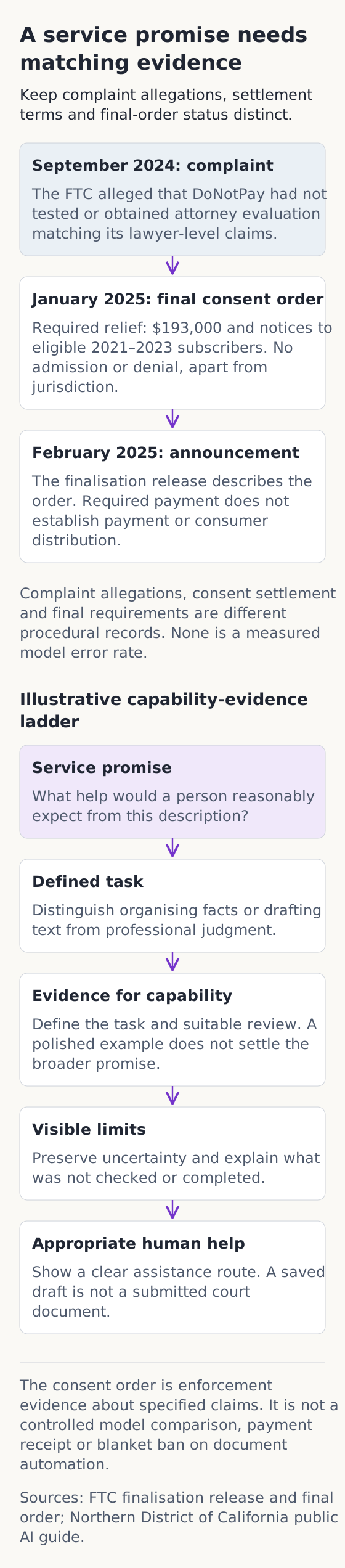
The FTC enforcement timeline and an illustrative evidence ladder separate a drafting feature from a promise to replace professional expertise.
[Open the complete evidence diagram](/assets/legal-workflow-robot-lawyer-claims-20261015.svg)
Read the diagram
**A service promise needs matching evidence**
Keep complaint allegations, settlement terms and final-order status distinct.
- **September 2024: complaint.** The FTC alleged that DoNotPay had not tested or obtained attorney evaluation matching its lawyer-level claims.
- **January 2025: final consent order.** Required relief: $193,000 and notices to eligible 2021–2023 subscribers. No admission or denial, apart from jurisdiction.
- **February 2025: announcement.** The finalisation release describes the order. Required payment does not establish payment or consumer distribution.
Complaint allegations, consent settlement and final requirements are different procedural records. None is a measured model error rate.
Illustrative capability-evidence ladder
- **Service promise.** What help would a person reasonably expect from this description?
- **Defined task.** Distinguish organising facts or drafting text from professional judgment.
- **Evidence for capability.** Define the task and suitable review. A polished example does not settle the broader promise.
- **Visible limits.** Preserve uncertainty and explain what was not checked or completed.
- **Appropriate human help.** Show a clear assistance route. A saved draft is not a submitted court document.
**Reading the evidence.** The consent order is enforcement evidence about specified claims. It is not a controlled model comparison, payment receipt or blanket ban on document automation.
*Sources: FTC finalisation release and final order; Northern District of California public AI guide.*