The simulation result is only as portable as its assumptions
Fraunhofer research and simulator documentation suggest keeping a readable assumptions register beside every sim-to-real comparison.
A simulated robot can repeat a successful grasp all afternoon without touching a real part. That is useful: engineers can explore configurations, expose mistakes and compare ideas before consuming equipment time. But the result travels with assumptions about contact, sensing, timing and the environment. A manufacturing team needs to know which assumptions were varied, which were measured and which were simply convenient defaults.
The most useful simulation handover is therefore an explanation of the gap between the virtual task and the physical one. A polished rendering may help someone understand a motion. It cannot establish that the real fixture is aligned, that a worn gripper behaves like its model, or that the accepted simulation settings are still in use after an update. This article proposes an assumptions register that accompanies the learned policy into physical evaluation.
What the primary records actually describe
In its [2 June 2025 cognitive-robotics account](https://www.fraunhofer.de/en/press/research-news/2025/june-2025/cognitive-robotics-and-new-safety-technologies-for-human-robot-collaboration.html), Fraunhofer IFF described simulated assembly and disassembly tasks, including removing a computer motherboard. The researchers distinguished making a simulation more realistic from exposing learning to varied versions of an environment. Domain randomization was one method used to address that difference. This is an institutional research description, not a transferable production acceptance result.
The [2017 domain-randomization paper](https://arxiv.org/abs/1703.06907), submitted on 20 March, studied training on rendered images with varied properties for transfer to real images. Its historical scope matters. It gives a clear example of varying a training environment; it does not prove that arbitrary contact-rich manufacturing operations become reliable merely by adding randomness. Visual transfer and the behaviour of a loaded mechanism are different questions.
The living [MuJoCo modeling documentation](https://mujoco.readthedocs.io/en/stable/modeling.html) explains how contact parameters are set, including rules for combining properties when contacts arise between geometries. This makes a practical point visible: a simulator’s contact behaviour is configured rather than discovered automatically from the real workpiece. The page’s publication date was not established in this review, so the 15 October 2026 access date is not presented as a release date.
The current [Isaac Lab reproducibility documentation](https://isaac-sim.github.io/IsaacLab/main/source/features/reproducibility.html) also conditions repeatability on hardware and simulator versions, and notes limitations for non-rigid bodies. A repeatable run is valuable evidence that a configuration can be reproduced. It is not evidence that its assumptions match a physical plant. Those two properties should occupy different lines in an engineering report.
A fictional disassembly trial
Imagine a fictional adult engineering team in Magdeburg evaluating removal of a reusable cover from returned industrial controllers. This example is invented; it does not describe Fraunhofer’s equipment or results. The cover can arrive with a different surface finish, a slightly misplaced fastener or a distorted edge. The team wants to investigate a learned manipulation policy while keeping the physical trial within its separately reviewed operating limits.
It begins with a task boundary: lift an already released cover from a known fixture and place it on a clear support. Removing an unknown fastener, cutting a seal or reaching into an energised controller is outside the exercise. This choice makes it possible to ask a precise question about manipulation rather than treating every reason for a failed disassembly as a model error.
The assumptions register has a row for each consequential property. For the cover, it records the range of mass represented, the surface contact assumptions and the initial pose. For the robot, it records the gripper geometry, control interval and sensing delay. Each row names its origin: a measurement, a supplier document, an engineering estimate or an unresolved placeholder. The categories should remain visible even if all the values fit neatly into one configuration file.
Vary properties for a reason
Randomization is most informative when a variation represents a plausible uncertainty. The team might vary illumination because the station has different lighting conditions across shifts. It might vary cover position because the fixture admits a known range of placement. It should explain why the chosen range is relevant. Making a range extremely wide does not automatically make the eventual policy more credible; it may instead change the task into a different problem.
The team then separates training conditions from evaluation conditions. It keeps some combinations out of training and records that choice before inspecting the results. A held-out combination is a test of the stated experimental boundary, not a guarantee about every future cover. If the team changes the range after seeing a failure, it preserves the earlier result and records a new experiment rather than retroactively describing the old trial as broader than it was.
Contact deserves its own review. A visually accurate controller cover can still behave differently when it catches on a locating pin. An engineer can compare simple physical observations with the modeled behaviour before moving to the full task. Where a mismatch remains unexplained, the correct report says so. Adjusting a parameter until a demonstration succeeds is not the same as identifying the physical source of the mismatch.
A measured bridge to equipment
For a worked handover, the fictional team prepares a small comparison sheet. One column describes the virtual condition, another describes the corresponding physical condition, and a third records the observed difference. It includes failed releases, ambiguous sensor readings and interventions. It records the exact policy and environment versions together, so a later simulator update cannot silently inherit the earlier physical result.
Physical evaluation then answers a narrower question: how did this configuration behave on these covers under these controlled conditions? It should include the operator’s recovery work and the final condition of the part, not merely whether the cover ended near the destination. A policy that reaches the goal after bending the cover has not met a preservation requirement. A simulation reward may need revision if it omitted that requirement.
The potential benefit is better directed equipment time. A documented virtual failure can reveal a weak assumption before a physical trial; a documented physical mismatch can improve the next simulation. Neither benefit is quantified here. Simulation cost, engineering effort and transfer performance depend on the task and were not measured for this fictional example.
Keep the assumptions with the result
The useful output is a linked set of artifacts: task definition, assumptions register, training configuration, retained failures and scoped physical observations. A person receiving the policy should be able to see what changed since its last evaluation. “Works in simulation” is then a starting description with inspectable contents, rather than a label that conceals how much remains unknown.
Germany’s research example, historical domain-randomization work and current simulator documentation support careful experimentation. They do not remove the need for a plant-specific assessment. The practical discipline is to carry the assumptions forward until equipment observations replace them, and to preserve the distinction whenever they do not.
Evidence diagram and readable guide
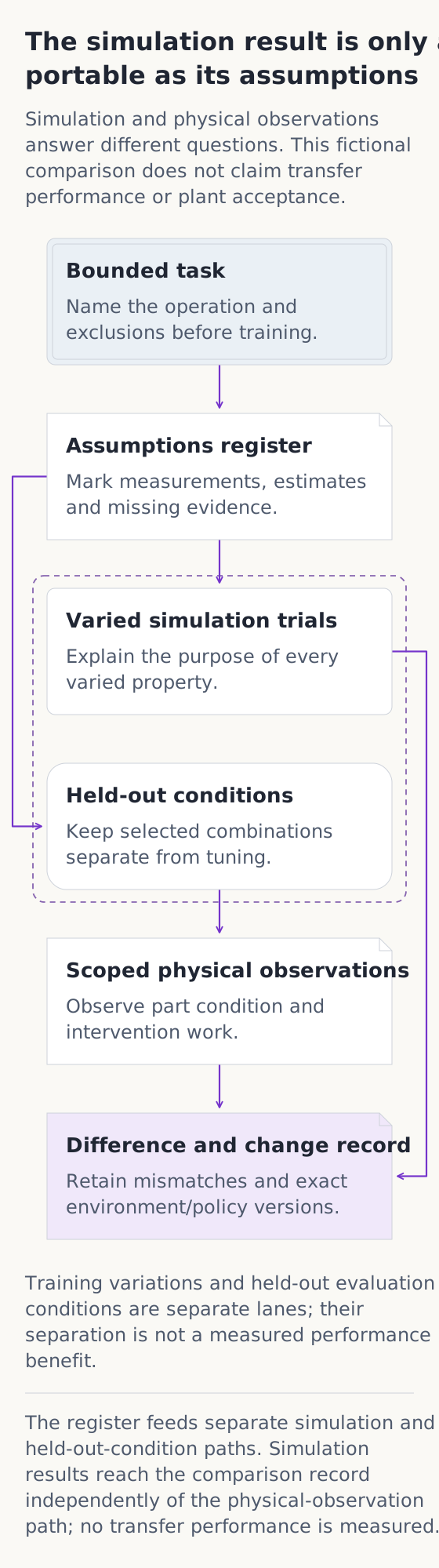
Original explanatory diagram: simulation and scoped physical observations reach a comparison record through separate paths.
[Open the complete evidence diagram](/assets/manufacturing-workflow-simulation-assumptions-20261015.svg)
Read the diagram
**The simulation result is only as portable as its assumptions**
Simulation and physical observations answer different questions. This fictional comparison does not claim transfer performance or plant acceptance.
- **Bounded task.** Name the operation and exclusions before training.
- **Assumptions register.** Mark measurements, estimates and missing evidence.
- **Varied simulation trials.** Explain the purpose of every varied property.
- **Held-out conditions.** Keep selected combinations separate from tuning.
- **Scoped physical observations.** Observe part condition and intervention work.
- **Difference and change record.** Retain mismatches and exact environment/policy versions.
Training variations and held-out evaluation conditions are separate lanes; their separation is not a measured performance benefit.
The register feeds separate simulation and held-out-condition paths. Simulation results reach the comparison record independently of the physical-observation path; no transfer performance is measured.
How the connections work
- Bounded task to Assumptions register: task definition; solid directed link. Proposed conditional or evidence flow; no measured causal relationship.
- Assumptions register to Varied simulation trials: configured variation; solid directed link. Proposed conditional or evidence flow; no measured causal relationship.
- Assumptions register to Held-out conditions: evaluation design; solid directed link. Proposed conditional or evidence flow; no measured causal relationship.
- Varied simulation trials to Difference and change record: simulation result; solid directed link. Proposed conditional or evidence flow; no measured causal relationship.
- Held-out conditions to Scoped physical observations: comparison condition; solid directed link. Proposed conditional or evidence flow; no measured causal relationship.
- Scoped physical observations to Difference and change record: physical evidence; solid directed link. Proposed conditional or evidence flow; no measured causal relationship.
Keep the paths separate
Training variations and held-out evaluation conditions are separate lanes; their separation is not a measured performance benefit.