The useful AI result in SN 2023zkd was a reason to keep watching
An unusual stellar explosion shows how an anomaly alert, observing decisions and a physical hypothesis contribute different parts of a discovery.
A star's changing brightness can become scientifically valuable before anyone agrees what caused it. SN 2023zkd offers a concrete example. A research collaboration including Harvard, MIT and Kyoto University investigated an unusual supernova whose light rose to another peak. Their preferred explanation involves a massive star interacting with a black-hole companion. That is an interpretation of observations, not a photograph of a black hole swallowing a star. [Research paper](https://arxiv.org/html/2502.19469v1).
The chronology makes the machine-learning contribution clearer. The paper records discovery by the Zwicky Transient Facility on 7 July 2023, followed by a LAISS anomaly flag on 18 January 2024. The February 2025 preprint therefore describes an alert after discovery, rather than an algorithm independently discovering the entire event. The practical achievement was directing attention while more observations could still be collected. [Observation history](https://arxiv.org/html/2502.19469v1).
An institutional account published on 13 August 2025 describes how that warning supported follow-up before the unusual later brightening. It connects the software to an observing campaign involving people and telescopes. The account presents a possible new stellar-explosion scenario, while retaining alternative explanations. Its news date should not be confused with the discovery date, alert date or first public manuscript. [Harvard–Smithsonian account](https://www.cfa.harvard.edu/news/ai-helps-astronomers-discover-new-type-supernova).
A queue for attention, followed by physical evidence
LAISS means Lightcurve Anomaly Identification and Similarity Search. Its methods paper describes a random-forest classifier using brightness-history features and information about the host galaxy, alongside approximate searches for similar transients. Candidates receive expert vetting and requests for follow-up. An unusual score concerns resemblance to the reference collection; it does not directly name the physical engine of an explosion. [LAISS methods](https://arxiv.org/html/2404.01235v2).
That division suggests a useful way to read discovery headlines. Ask which decision changed because of the model. Was an object placed in a queue, assigned a tentative class, scheduled for a spectrum or given a physical explanation? These are different achievements. Keeping them separate gives software its proper credit and makes the contribution of observers, instrument teams and interpretation visible.
The Young Supernova Experiment's foundational paper describes a time-domain survey designed to find and follow stellar explosions. A survey supplies repeated opportunities to observe changing objects; a follow-up programme supplies additional kinds of evidence. The collaboration's published observing strategy is relevant context, rather than proof that every interesting transient receives complete coverage. [Survey design](https://openaccess.inaf.it/server/api/core/bitstreams/b1d7233d-15f9-4288-a146-522759c2012e/content).
For a reader, a light curve and a spectrum answer different questions. A useful reading exercise is to write beside each plot what was measured and what was inferred. Brightness through a filter is an observation with uncertainty. A proposed stellar history belongs in a separate column. This simple annotation prevents a compelling narrative from silently becoming an additional measurement.
The SN 2023zkd manuscript reports precursor emission, a double-peaked light curve and hydrogen- and helium-related spectral structure. Its authors compare possible progenitors and favour an instability-induced merger involving a black-hole companion. The interpretation depends on modelling and on how those observations fit together; the paper does not report a directly observed companion. [Observations and interpretation](https://arxiv.org/html/2502.19469v1).
What a research team could reuse
The LAISS authors deposited a version of their code and supporting material in June 2024. A preserved software release is a more useful starting point for methodological study than a screenshot of an anomaly dashboard. It gives future investigators something identifiable to inspect, while not establishing that a fresh installation or a different survey will reproduce the published behaviour. [Research software record](https://zenodo.org/records/11541806).
A proposed student project could begin with the release description, then document its required inputs before attempting any analysis. Record which brightness features are available, what host information is missing and which objects would be rejected. This is a preparation exercise, not a claim that this publication installed the software, obtained telescope time or reproduced the study.
The methods paper discusses selection effects, including the exclusion of objects without suitable host information, and failure modes involving contaminants or unusual sampling. Those details explain why an apparent absence from an anomaly list cannot establish that the sky contained no interesting event. A reference collection has a footprint, and so does the information needed to score a candidate. [Selection and limitations](https://arxiv.org/html/2404.01235v2).
For an observing team, an appropriate next step would be to evaluate the whole queue, including objects that were never followed up. Proposed records should retain the alert time, available observations, scheduling decision and eventual classification. Otherwise a retrospective showcase can reward only memorable successes and omit the ordinary candidates that consumed attention or lacked a later answer.
An invented observing-room exercise
Imagine a classroom with a fictional transient called Lantern. Students receive a synthetic brightness history that initially fades, together with an explicit gap in observations. A second, separately labelled envelope contains a later synthetic measurement. None of these values represent SN 2023zkd, and this exercise has not been performed. Its purpose is to practise decisions with incomplete information.
Before opening the second envelope, each group writes a proposed observation request and explains what uncertainty it would reduce. One group might want another brightness measurement; another might ask what a spectrum could distinguish. They must also write what they cannot conclude. The assessment concerns the reasoning behind the request, rather than whether a group guesses the instructor's eventual story.
After revealing the additional synthetic point, students revise their notes without rewriting the earlier decision. The worked conclusion is that the endpoints cannot establish continuous fading across the observation gap. If several explanations remain, the group must retain them. This makes the exercise about learning from evidence rather than constructing an inevitable discovery after seeing the ending.
Now ask what would have happened if Lantern had lacked a reliable host association. Students can describe how a software input requirement changes who enters the queue. They should not invent a replacement galaxy or silently fill a missing field. The resulting discussion connects data engineering to scientific opportunity without pretending to reproduce an astronomical survey's measured completeness.
Follow-up is a scientific resource
The institutional SN 2023zkd account makes human follow-up central to the story. It does not provide a universal rate at which AI warnings become new kinds of supernova, or establish that every alternative progenitor has been excluded. The interesting result is a particular observing opportunity and a developed physical hypothesis, not a general conversion rate from alerts to discoveries. [Institutional interpretation](https://www.cfa.harvard.edu/news/ai-helps-astronomers-discover-new-type-supernova).
This suggests practical work for researchers entering the field: understand observation timestamps, identify the version of the selection software and learn how a follow-up decision is recorded. Software skills are useful when they make those records easier to inspect. A polished explanation written after the event cannot compensate for an observation that was never obtained.
For science communicators, a responsible illustration would show an observing team examining a clearly schematic brightness history. It should not present an invented image as the actual event, or render a hypothetical companion as directly photographed. The distinction leaves room for wonder: the real story is that an unusual pattern led people to ask better questions while the sky was still changing.
SN 2023zkd is therefore a useful case for understanding scientific AI as part of an observing practice. The model helped select attention; telescopes and analysis supplied additional evidence; the authors proposed an explanation that can be challenged. Keeping that chain intact makes the reported development more informative than a claim that software solved the event on its own.
Conceptual diagram and reading companion
Original conceptual illustration and unperformed classroom exercise; no measured data, authentic research interface or reproduced result is shown.
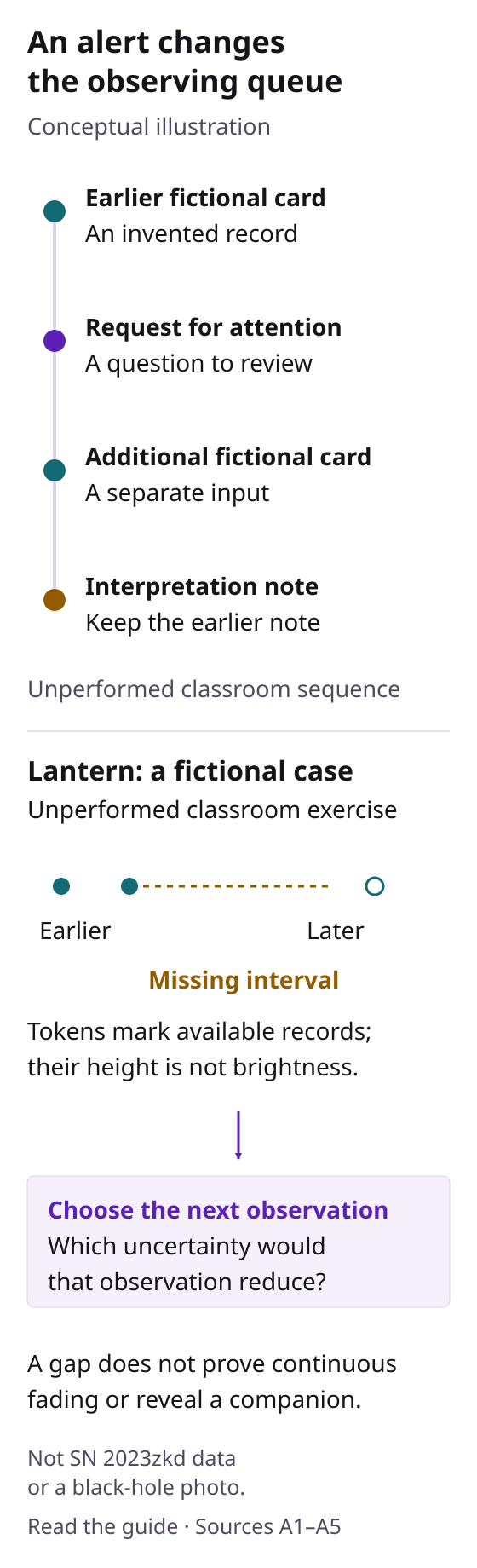
Original conceptual illustration supporting this article. Shapes and teaching examples are explanatory, not measured data, an authentic laboratory interface or an independent reproduction. Read the accompanying source-linked guide.
[Open the complete diagram](/assets/science-supernova-follow-up-concept-20261016.svg)
An alert changes the observing queue
A conceptual reading companion to the article's invented Lantern exercise. No observations are collected and no real event is diagnosed here.
Keep Lantern's observation gap visible
For the fictional exercise, read the earlier and later tokens as available cards. The dashed span is deliberately empty. The token height is not a brightness axis, and the space between cards is not a calibrated clock. Keep the missing card in the account rather than drawing an imagined connecting curve.
Before the hypothetical reveal, write an observation request and the question it could address. After the reveal, keep that original request beside the revised interpretation. The useful comparison concerns the reasons for the request; this companion supplies no answer key, numerical outcome or claim that the class ran.
The upper panel uses different labels for a record, a request for attention, later evidence and an interpretation. Read the article's unchanged reporting for named dates and source qualifications. The labels are transcribed below for accessibility; no step or arrow asserts that this publication operated a telescope.
Readable figure labels
- An alert changes - the observing queue - Conceptual illustration - Earlier fictional card - An invented record - Request for attention - A question to review - Additional fictional card - A separate input - Interpretation note - Keep the earlier note - Unperformed classroom sequence - Lantern: a fictional case - Unperformed classroom exercise - Earlier - Later - Missing interval - Tokens mark available records; - their height is not brightness. - Choose the next observation - Which uncertainty would - that observation reduce? - A gap does not prove continuous - fading or reveal a companion. - Not SN 2023zkd data - or a black-hole photo. - Read the guide · Sources A1–A5
Source context
For the reported facts, dates and access limitations, read the unchanged article above. These are the same underlying references, not additional experiments. The fictional exercise and diagram do not establish a measured result.
- [A1](https://arxiv.org/html/2502.19469v1) - [A2](https://www.cfa.harvard.edu/news/ai-helps-astronomers-discover-new-type-supernova) - [A3](https://arxiv.org/html/2404.01235v2) - [A4](https://zenodo.org/records/11541806) - [A5](https://openaccess.inaf.it/server/api/core/bitstreams/b1d7233d-15f9-4288-a146-522759c2012e/content)