Tokenised payment trials make the stages behind an instruction visible
Mandala, Agorá and EnsembleTX reveal distinct stages of programmable finance, including controlled real-value trials and the limits of an AI explanation.
“Make the payment” hides a sequence of questions. What is being transferred? Which institution is responsible for it? What conditions must be satisfied? Has a settlement occurred, or has an instruction merely been received? An AI interface may help someone understand that sequence, but a convincing sentence cannot answer all of those questions. Recent tokenisation experiments make the underlying work easier to see.
BIS’s Project Mandala describes a compliance-by-design architecture with messaging, rules and proof engines. Its account separates pre-validation and a proof from the later payment instruction, and its November 2025 Phase 2 update describes further research and empirical evaluation. This is a proof-of-concept programme, not a universally applicable compliance certificate. A rules engine or cryptographic proof also should not be labelled AI simply because an assistant might eventually describe its output. [BIS’s Mandala project record](https://www.bis.org/project/mandala).
Project Agorá provides another stage of evidence. BIS’s current project page describes a prototype and controlled real-value testing in July 2026 using tokenised central-bank reserves and commercial-bank deposits. That is stronger than a paper-only proposal, but it remains a scoped experiment rather than a finished commercial service. The living page contains an earlier May report label alongside later testing material; the exact latest edit date cannot be established from that label alone. [BIS’s Agorá project record](https://www.bis.org/project/agora).
The asset, the instruction and the evidence
Tokenisation can help represent financial claims and coordinate steps on compatible infrastructure. It does not make all financial objects interchangeable. A deposit token, a central-bank reserve representation and an independently issued cryptoasset have different issuers, rights and operating arrangements. A learner needs to understand what a particular exercise represents before discussing whether a transfer was successful.
The same care applies to automation. A conditional workflow can follow specified rules without being a machine-learning model. An assistant can generate an explanation without being the component that checks those rules. Combining these functions in a demonstration should not erase their separate responsibilities. Otherwise a user may interpret the assistant’s description of an expected outcome as confirmation that the underlying system reached it.
In an October 2026 speech, MAS described tokenisation’s challenge as scaling commercial adoption through common standards, trusted infrastructure and appropriate legal treatment. Its discussion connected the economic activity to existing securities-law outcomes rather than suggesting that a token label creates an exemption. The same speech described SAFR runtime governance: establishing agent identity and authority, checking proposed actions against a user mandate, and retaining accountability and auditability. It reported a Version 1.1 white paper and an open-source reference implementation; neither was independently inspected here. This is an attributed speech account, not a legal opinion, a tested deployment or proof that every platform now interoperates. [MAS’s 9 October speech](https://www.mas.gov.sg/news/speeches/2026/building-trusted-foundations-for-digital-finance).
Hong Kong’s EnsembleTX announcement supplies a specific pilot boundary. In November 2025, HKMA described real-value tokenised-deposit and digital-asset transactions in a controlled pilot planned to operate through 2026. Initial interbank settlement used the HKD RTGS system, while further tokenised central-bank-money and round-the-clock capabilities were planned enhancements. The release does not establish that every enhancement had been completed by this article’s check date. [HKMA’s EnsembleTX launch](https://www.hkma.gov.hk/eng/news-and-media/press-releases/2025/11/20251113-3/).
These accounts show why the interesting question is not merely whether a transaction touches a blockchain. It is how a defined financial arrangement moves from an intention, through applicable checks and coordination, to a supported record of what occurred. The named initiatives have different participants and scopes. They should not be combined into a fictional single platform or evidence that one experiment validates another.
A paper-only payment exercise
Consider fictional adult learners in a Hong Kong operations workshop. They use cards representing an imaginary deposit claim, a synthetic payment request and a separate receiving record. There is no wallet, account connection, real money or network. The facilitator explains that the cards are teaching aids, not replicas of Mandala, Agorá or EnsembleTX.
First, the learners describe the intended transfer in plain language. They identify the represented asset and the roles of the fictional participants. If two people disagree about what the card represents, they resolve that before asking an assistant to explain the transaction. A shared word such as “token” is not enough to establish a shared financial meaning.
Next, the facilitator introduces a separate check record. It covers only the conditions listed for this invented exercise. Learners must not describe it as a guarantee that all legal requirements everywhere are satisfied. They practise explaining a narrow result: the listed conditions were checked against the supplied material. This distinction also prevents a model-generated explanation from expanding the scope of a technical proof.
The group then receives an acknowledgement that a request was received, without a settlement record. An assistant that writes “the payment is complete” has supplied a fact the materials do not contain. A more useful answer names the current state and the missing evidence. It can explain what the group would need to inspect next without automatically submitting another request.
Finally, the facilitator supplies either a receiving record or an explicit unresolved state. Learners compare the represented asset, parties and reference across the cards. A mismatch is retained for discussion rather than repaired by guessing. The exercise ends with a record of the conclusion and its support; it does not operate a real payment system or establish a professional qualification.
Why these distinctions matter for AI
Financial assistants can make unfamiliar processes more accessible. They may help a new colleague ask what an acknowledgement means, locate the relevant operating explanation or notice that two records describe different stages. Those are useful learning tasks. They are different from authorising a payment, interpreting law for a customer or guaranteeing that a settlement cannot fail.
The potential operational benefit of programmable arrangements is coordination: conditions and transfers may be represented in ways that reduce repeated handoffs. The cost is not only software development. Participants still need agreement about roles, data access, exceptional cases and what to do when the expected record does not arrive. A successful controlled test provides evidence for its tested conditions, not for every future interruption.
An AI evaluation can therefore ask whether people understand the process better after using the assistant. Can they distinguish the asset from the instruction? Can they explain which checks were completed? Can they identify an unresolved outcome without treating it as either success or permission to resend? Those observations would be more informative than judging the assistant only on how confidently it describes tokenisation.
The public experiments demonstrate substantial technical work and different degrees of real-world testing. They also show why financial automation cannot be reduced to a natural-language request. The useful educational outcome is a clearer view of the stages, responsibilities and evidence behind a transaction, while preserving the boundary between an explanation and an event that actually occurred.
Evidence diagram and readable guide
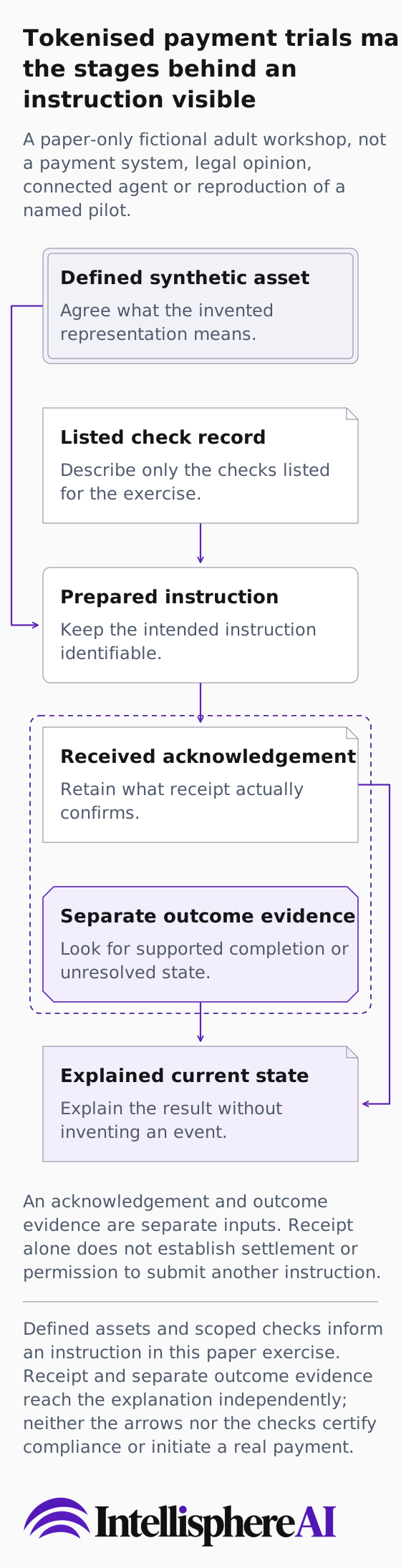
Original explanatory diagram: a fictional paper exercise separates a synthetic asset, scoped checks, instruction, receipt and outcome evidence; no payment or compliance certificate is shown.
[Open the complete evidence diagram](/assets/crypto-evidence-tokenised-settlement-20261016.svg)
Read the diagram
**Tokenised payment trials make the stages behind an instruction visible**
A paper-only fictional adult workshop, not a payment system, legal opinion, connected agent or reproduction of a named pilot.
- **Defined synthetic asset** Agree what the invented representation means.
- **Listed check record** Describe only the checks listed for the exercise.
- **Prepared instruction** Keep the intended instruction identifiable.
- **Received acknowledgement** Retain what receipt actually confirms.
- **Separate outcome evidence** Look for supported completion or unresolved state.
- **Explained current state** Explain the result without inventing an event.
An acknowledgement and outcome evidence are separate inputs. Receipt alone does not establish settlement or permission to submit another instruction.
How the connections work
- The defined synthetic asset constrains the meaning of the prepared instruction.
- The listed checks supply scoped context, without certifying every legal requirement.
- The prepared instruction leads to a receipt stage within the paper exercise.
- The acknowledgement informs the explanation only to the extent it confirms receipt.
- Separate outcome evidence determines what completion or unresolved state can be explained.
Relationship key
Defined assets and scoped checks inform an instruction in this paper exercise. Receipt and separate outcome evidence reach the explanation independently; neither the arrows nor the checks certify compliance or initiate a real payment.