TrialGPT 2.0 is testing a harder question: which cancer trials deserve a closer look?
A September 2026 preprint brings AI matching into oncology review workflows; European TrialMatchAI offers a separate approach, with enrollment still a distinct outcome.
A patient can appear eligible for several clinical trials while none is practical or appropriate to pursue at that moment. A recruitment team must reconcile clinical records, detailed criteria, local availability and a clinician's judgment. Search is only the beginning of that work.
TrialGPT 2.0, described in a September 2026 preprint led by National Library of Medicine researchers and collaborators, moves towards that broader problem. Its evaluations include an active precision-oncology workflow. A separate European programme, TrialMatchAI, shows another route through the same information bottleneck. The promising development is more inspectable candidate finding, with enrollment and patient benefit still requiring their own evidence.
From matching criteria to recommending further review
The [TrialGPT 2.0 preprint](https://arxiv.org/html/2609.01202v1) was submitted on 1 September 2026. It separates supporting eligibility evidence, potential incompatibilities and missing information, then ranks candidates according to a specified review policy. That policy matters: a team looking for therapeutic studies may prioritise differently from a referral office handling a broader research portfolio.
The evaluation used 288 de-identified cases across retrospective settings, comprising 1,340 patient–trial pairs. Those are different denominators. One person can be compared with several studies. A successful pair classification therefore cannot be read as one additional participant recruited.
The prospective result needs its denominator
The paper also describes review during a precision-oncology tumour board from February through July 2026, covering 27 cases and 339 patient–trial pairs. The meaningful advance is that outputs were considered in a working clinical review process, rather than only scored against a static benchmark.
Its headline about expanded access needs careful reading. The described review endpoint concerns additional trial options entering final recommendations. That is not equivalent to completed consent, enrollment or improved health. This article therefore does not repeat the abstract's relative access figure as an enrollment gain. The September record is a preprint; independent replication and subsequent publication remain separate.
A different European pipeline supplies a useful comparison
[TrialMatchAI](https://www.nature.com/articles/s41467-026-70509-w), published in Nature Communications on 25 March 2026, involves researchers at Bordeaux, Oslo and Barcelona institutions. It combines biomedical entity processing, retrieval, re-ranking and criterion-level reasoning, using fine-tuned language models and traceable explanations.
The programme describes validation using synthetic and real clinical data and an architecture supporting local deployment. Those are design and evaluation claims from its authors. They do not show that an unreviewed installation can safely process any hospital's records. Nor can its top-20 retrieval findings be compared directly with TrialGPT's top-10 recommendation metric: list length, populations and judgments differ.
Four stages that should never be merged
| Stage | Question answered | Suitable evidence | | --- | --- | --- | | Candidate retrieval | Did a plausible trial enter the shortlist? | Recall and documented search scope | | Expert recommendation | Does this option warrant further consideration? | Clinician review of evidence and missing facts | | Enrollment | Did the person enter the study after the required process? | Verified recruitment records | | Patient benefit | Did participation improve a meaningful outcome? | Appropriate clinical outcome evidence |
The [NLM terms](https://www.ncbi.nlm.nih.gov/research/trialgpt/terms/), effective 21 August 2026, describe TrialGPT as a research tool supporting screening and information use. The [FAQ](https://www.ncbi.nlm.nih.gov/research/trialgpt/faq/) identifies it as experimental. These official operating boundaries are records from the same programme, not extra efficacy studies.
A fictional referral coordinator's morning
Consider a fictional cancer research office in Manchester using invented records for a training exercise. This is not a report of a UK TrialGPT deployment. A coordinator has a short referral summary, an older molecular report and a list of studies supplied for the exercise. Some trial entries have changed their recruitment status.
The assistant produces a shortlist. One candidate has a strong disease match but a required laboratory result is absent. Another appears compatible with an older record but conflicts with a newer note. The coordinator marks the first as requiring information and the second as requiring reconciliation. Neither becomes an automated invitation to a patient.
Missing information is useful output
An assistant that writes a confident yes or no for every criterion may hide the most important work. In the fictional case, the absence of a result does not mean the result is normal, abnormal or unobtainable. The display should show the relevant criterion, the source passage and what remains unknown.
Dates are especially important. A previous measurement may be accurate yet unsuitable for a criterion requiring a recent observation. A statement copied through several notes can also appear current when its origin is old. The coordinator needs the original date and the model's interpretation in separate fields, with a reviewer able to correct the latter.
This workflow is an editorial proposal, not an observed outcome from either cited system. It illustrates why a useful explanation should allow a reader to challenge a decision. A fluent paragraph that cannot be tied back to a source is difficult to audit and can increase the team's workload.
Search coverage can create invisible exclusions
The shortlist is only as broad as the supplied portfolio and the retriever's coverage. A system configured for a local institution cannot be described as searching all worldwide opportunities. Even a large registry does not settle whether a particular site has capacity or whether a record is up to date.
An evaluator should therefore record the trial collection, retrieval date, languages and available clinical information. Include cases where the right answer is that no relevant option was found within this search. That wording preserves the boundary. Saying no trial exists would assert much more than the system established.
Geography also shapes the practical meaning of a match. Travel, local arrangements and a person's preferences require discussion through the proper care and research process. They cannot be inferred from a disease label. This article does not recommend a study or interpret anyone's eligibility.
What teams should measure beyond minutes saved
Useful evaluation would count omitted clinician-recommended candidates, unsupported matches and the work needed to resolve uncertainty. Screening time can be measured, but should include checking explanations and correcting records. An improvement in one coordinator's review task is not automatically an improvement in the whole recruitment pathway.
Track how often the shortlist changes a discussion and how often those changes survive expert review. If enrollment is later measured, retain its actual denominator and the reasons people did not proceed. A declined invitation is not necessarily a system failure; participation remains voluntary and subject to the study's proper process.
New skills for research workers and students
Recruitment staff bring detailed knowledge of protocols, missing documentation and practical constraints. AI can change the balance between searching and checking, creating more work in evidence reconciliation and explanation. The cited research does not establish a staffing reduction or justify replacing the people responsible for those judgments.
A student can create an entirely fictional protocol and record set, then build a table of satisfied, contradicted and unknown criteria. Add one amended criterion and show how the shortlist changes. This teaches temporal reasoning and source checking without uploading patient notes or presenting personal medical advice.
Follow this research through larger prospective evaluations, independent comparisons and clearly separated recruitment outcomes. This is educational, non-promotional reporting checked on 15 October 2026. Better matching can make opportunities easier to inspect; the human and clinical steps that turn an option into participation still matter.
Research pathway and readable guide
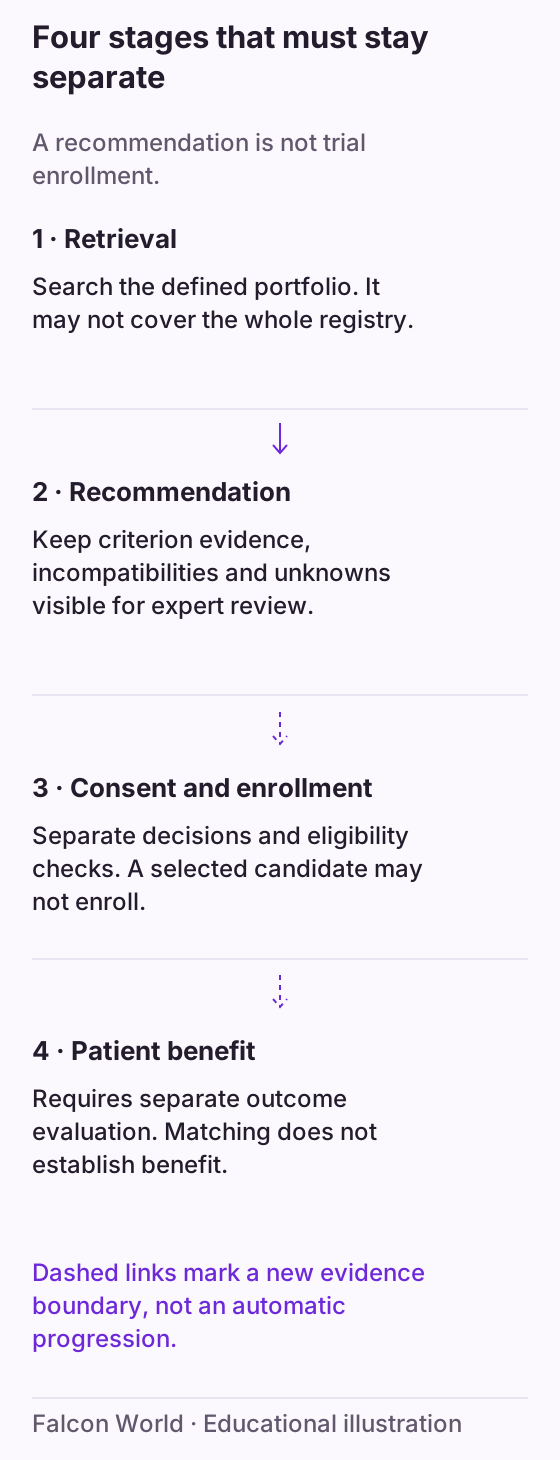
Original educational diagram of research boundaries and a fictional example. Not personal medical advice, a treatment instruction, regulatory approval or an actual clinical deployment.
[Open the complete research diagram](/assets/healthcare-workflow-trial-matching-20261015.svg)
Read the diagram
**Four stages that must stay separate**
A recommendation is not trial enrollment.
- **1 · Retrieval.** Search the defined portfolio. It may not cover the whole registry.
- **2 · Recommendation.** Keep criterion evidence, incompatibilities and unknowns visible for expert review.
- **3 · Consent and enrollment.** Separate decisions and eligibility checks. A selected candidate may not enroll.
- **4 · Patient benefit.** Requires separate outcome evaluation. Matching does not establish benefit.
**Dashed links mark a new evidence boundary, not an automatic progression.**
*Falcon World · Educational illustration*
These pathways describe different research tasks and evidence boundaries. An arrow does not establish that one study caused another or that a research finding leads automatically to clinical benefit.