Tutor CoPilot puts AI beside the human tutor, with feedback as the real intervention
Stanford’s revised Tutor CoPilot study and a separate Shanghai feedback experiment examine how assistance changes the next teaching move.
When a learner is stuck, a tutor has several possible moves: supply an answer, ask a question, offer an analogy or examine the earlier mistake. Knowing the subject does not always make that choice easy. Tutor CoPilot investigates whether an AI assistant can help a human tutor make a more productive next move during the conversation.
That arrangement differs from handing the student an autonomous chatbot. The research makes the tutor's behaviour part of the intervention. A separate experiment on chatbot feedback shows why the form of feedback deserves its own evaluation: correcting an answer and helping a learner monitor their reasoning are different educational actions.
The latest retained Tutor CoPilot version matters
The [November 2025 Tutor CoPilot working paper](https://scale.stanford.edu/sites/default/files/ai24_1054_v2.pdf) reports a randomised study involving more than 700 tutors and 1,000 students from underserved communities. Students whose tutors had access to the system were four percentage points more likely to master mathematics topics in the study's assessment.
The [Stanford SCALE record](https://scale.stanford.edu/ai/repository/tutor-copilot-human-ai-approach-scaling-real-time-expertise) identifies this version and describes the same research. Earlier circulating descriptions report a different sample. This article uses the November 2025 record rather than combining sample counts from versions. Four percentage points is an absolute difference in the assessed outcome, not a four-percent increase in all student learning.
The assistant supports a teaching decision
The human tutor remains the person interacting with the student. The assistant can suggest ways to respond, while the tutor decides how to use the help. This makes the design interesting for developing expertise: the system intervenes at the moment a teaching decision is needed rather than only delivering general training beforehand.
The authors' result supports the evaluated arrangement. It does not prove that every suggestion was good or that the same outcome follows from adding any model to any tutoring platform. The working-paper stage and the immediate topic-mastery measure should remain visible when discussing wider educational implications.
A separate feedback experiment asks about mechanism
The [npj Science of Learning feedback study](https://www.nature.com/articles/s41539-025-00311-8), published on 15 April 2025, analysed 87 university students in Shanghai, with 29 in each of three feedback groups. They studied biology material and received metacognitive, affective or neutral feedback. The researchers reported higher transfer scores with metacognitive feedback and examined brain activity using functional near-infrared spectroscopy.
This is a different experiment from Tutor CoPilot, with a different setting and intervention. Its measurements should not be treated as an explanation proven for the Stanford trial. Together, however, the programmes make a useful research question concrete: which feedback helps a learner revise an understanding, rather than merely accept the next answer?
Separate three kinds of evidence
| Evidence | What it can show | What remains unproved | | --- | --- | --- | | Tutor CoPilot randomisation | Effect of access to the studied human–AI support system | Every assistant suggestion's value | | Observed tutoring exchanges | How tutors' responses differ with assistance | A universal causal mechanism | | Feedback-type experiment | Outcomes under its specified feedback conditions | Replication of a live tutoring service | | Proposed training exercise | Whether a response is inspectable and useful to discuss | A measured attainment gain |
The table is an original comparison of evidence stages. It is not a ranking of products or a claim that the programmes used identical curricula, assessments or populations.
A fictional tutor-training workshop
Imagine a fictional university outreach team in Dublin using invented mathematics dialogues to train adult tutors. This is an illustrative example, not a local installation of Tutor CoPilot. A learner has reached the right numerical answer through an invalid cancellation. The assistant offers a polished explanation that overlooks the mistake.
The trainee must identify the gap and choose a response. One option asks the learner to explain the cancellation; another gives a simpler counterexample; a third supplies the full solution immediately. The workshop compares the reasoning behind these choices rather than awarding the assistant's suggestion automatic authority.
Useful feedback leaves room for the learner
A question can be technically correct and educationally unhelpful. Asking a learner to explain everything may impose too much work when they are confused about one small step. A good training example therefore includes enough context to identify what the learner has already understood and where the conversation should focus.
The fictional workshop includes a learner who makes a valid alternative argument. Trainees check whether the assistant can accommodate it or mechanically repeats the expected solution. It also includes a case with insufficient information. The system should be able to say that it needs another step, rather than inventing the learner's reasoning.
These are proposed exercises informed by the research questions. They are not reported features or measured effects of either cited system. Their purpose is to make a tutor's judgment inspectable, including the decision to ignore an unsuitable suggestion.
Tutor learning needs a different outcome measure
A short-term improvement in a student's topic assessment does not establish that the tutor has acquired a lasting new skill. A programme interested in professional development should examine whether tutors later recognise similar situations without assistance and can explain why a response is appropriate.
That evaluation should distinguish a system suggesting a useful question from a tutor understanding its purpose. Repeating the wording can look like improved practice while remaining brittle when the next learner responds unexpectedly. Observations after assistance is withdrawn would answer a different question from observations made while the assistant is available.
For students, an important question is whether the support encourages them to reveal uncertainty. A tutoring interaction that rewards only quick correct answers may discourage the very explanations a tutor needs. Interface choices and assessment incentives can shape what the model is able to observe.
Protect the conversation as learning material
Real tutoring exchanges can contain names, family circumstances and sensitive information that was never needed for the subject task. An institution should determine the appropriate service and data arrangements before using real records. For children, safeguarding and adult oversight are integral to the programme, not a claim satisfied by a generic chatbot warning.
The fictional workshop needs none of that material. Invented dialogues can expose answer-giving, ambiguity and unsuitable feedback without creating a collection of children's conversations. If an assistant fails during a real authorised session, the tutor should retain the lesson context and have a workable way to continue.
What this changes about tutoring work
The research points towards work in selecting, adapting and explaining feedback. Experienced tutors can identify cases where a suggestion sounds reasonable but misses a learner's misconception. Less experienced tutors may benefit from support, while still needing subject knowledge and opportunities to practise independent judgment.
Developers should evaluate the entire suggestion-to-response chain. A useful recommendation that arrives too late or obscures the student's last message may not help. Measures of adoption should remain separate from measures of educational quality: tutors can frequently click a suggestion without improving the lesson.
No verified staffing saving or replacement of tutors follows from these studies. The next convincing evidence would connect immediate student outcomes with durable tutor learning and implementation in new settings. This is educational, non-promotional reporting checked on 15 October 2026; the fictional exercises do not constitute a validated intervention or advice to upload student records.
Evidence diagram and readable guide
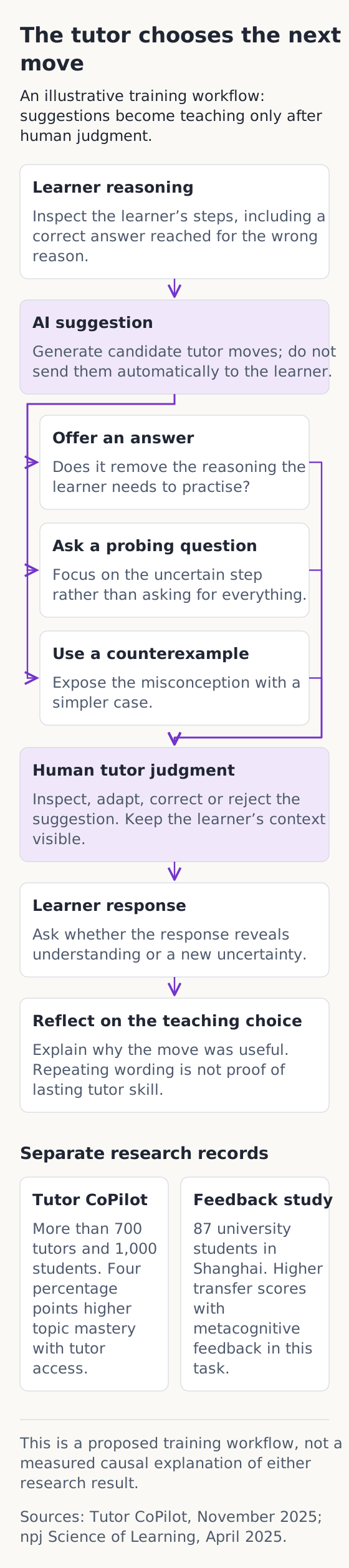
A tutor-training decision tree separates candidate AI suggestions from a human tutor’s decision and keeps two research programmes distinct.
[Open the complete evidence diagram](/assets/education-workflow-tutor-feedback-20261015.svg)
Read the diagram
**The tutor chooses the next move**
An illustrative training workflow: suggestions become teaching only after human judgment.
- **Learner reasoning.** Inspect the learner’s steps, including a correct answer reached for the wrong reason.
- **AI suggestion.** Generate candidate tutor moves; do not send them automatically to the learner.
- **Offer an answer.** Does it remove the reasoning the learner needs to practise?
- **Ask a probing question.** Focus on the uncertain step rather than asking for everything.
- **Use a counterexample.** Expose the misconception with a simpler case.
- **Human tutor judgment.** Inspect, adapt, correct or reject the suggestion. Keep the learner’s context visible.
- **Learner response.** Ask whether the response reveals understanding or a new uncertainty.
- **Reflect on the teaching choice.** Explain why the move was useful. Repeating wording is not proof of lasting tutor skill.
Separate research records
- **Tutor CoPilot.** More than 700 tutors and 1,000 students. Four percentage points higher topic mastery with tutor access.
- **Feedback study.** 87 university students in Shanghai. Higher transfer scores with metacognitive feedback in this task.
**Reading the evidence.** This is a proposed training workflow, not a measured causal explanation of either research result.
*Sources: Tutor CoPilot, November 2025; npj Science of Learning, April 2025.*
**Keep the comparisons separate.** Different interventions, populations and outcomes; no proven shared mechanism.