What CERN's AI anomaly searches can teach when no new particle appears
ATLAS and CMS research offers a practical account of unusual-event selection, known-process checks and scientifically useful null findings.
A search can advance a scientific method without finding a new particle. An ATLAS study first submitted in February 2025, with a revised manuscript dated 5 January 2026, used machine learning to look for unusual patterns in collision events. Its result was explicit: neither of its model-independent approaches showed a significant local excess. That null finding belongs at the beginning of the story. [ATLAS study](https://arxiv.org/html/2502.09770v2).
The analysis used proton collisions recorded during 2015–2018, rather than a newly collected 2026 dataset. It examined events containing a pair of jets, using weakly supervised classifiers to compare data with estimated background. The selected events were then examined for an excess in the jets' combined invariant-mass distribution. A high classifier score was an analysis selection, not a discovery certificate. [Data and method](https://arxiv.org/html/2502.09770v2).
This is a practical scientific-AI development because searches need ways to notice departures that a narrowly chosen signal template might miss. The difficult editorial task is to explain that goal without implying that every departure would be new physics. A mismatch could start a useful investigation while still ending with a better understanding of a familiar process or an analysis limitation.
Different ways to ask what looks unusual
ATLAS had previously described an unsupervised autoencoder search in an institutional briefing dated 24 August 2023. That system learned a representation of typical events and selected poorly reconstructed ones for further study. The briefing reported no significant deviation attributable to new physics. This earlier approach supplies context; it is not the same classifier or the same analysis as the later weakly supervised search. [Earlier ATLAS method](https://atlas-public.web.cern.ch/Updates/Briefing/Anomaly-Detection).
For a reader, the distinction matters more than the fashionable model name. One strategy asks whether an event reconstructs unusually; another compares populations using a background reference. Before comparing their performance, ask what each system sees and what its output means. The word anomaly alone does not make their scores interchangeable or their selected samples equivalent.
A CMS research report dated 23 December 2025 provides a complementary example. It describes machine-learning anomaly methods and a demonstration that recovers events consistent with boosted, already known top quarks. Detecting a known process in this setting is a methodological check. It should not be rewritten as a discovery of an unknown particle or as independent confirmation of the ATLAS analysis. [CMS report](https://cms-results.web.cern.ch/cms-results/public-results/publications/MLG-23-002/).
Together, these developments suggest a useful reading order: establish the reference, inspect the selection, then examine the statistical conclusion. Ask how a method behaves on data for which a conventional physical account already exists. A convincing demonstration of sensitivity can still leave open how the same procedure responds to detector effects, changing selections or a different kind of unexpected signal.
A background estimate is part of the instrument
The ATLAS study uses separate background-estimation strategies and validation procedures. It also injects representative simulated signals to assess sensitivity. An injected signal is a deliberately constructed test, not an event newly discovered in the collision archive. Limits and sensitivity therefore concern the stated analysis and scenarios; the null result does not establish that all possible new physics is absent. [Validation and results](https://arxiv.org/html/2502.09770v2).
A proposed reading notebook should place the background construction next to the classifier description. If a model separates the measured sample from an imperfect reference, it may be answering a question about the reference. That possibility should guide the questions asked of the authors' validation, rather than become an unsupported accusation that the reported analysis is wrong.
The earlier ATLAS briefing makes clear that anomaly detection complements searches with more specific hypotheses. It does not promise that a broad selection has equal reach for every possible phenomenon. A useful public explanation can therefore describe breadth as a research objective while retaining the actual tested conditions. Breadth should not become a substitute for a stated sensitivity study. [Search context](https://atlas-public.web.cern.ch/Updates/Briefing/Anomaly-Detection).
For researchers building transferable skills, the immediate opportunity is to understand how data selections become statistical questions. Document what was fixed before inspecting a result and what changed afterward. A proposed analysis diary should distinguish exploration from confirmation. That habit helps a collaborator assess a promising pattern without pretending that a classroom notebook satisfies a collaboration's discovery procedures.
An invented search with a deliberately planted problem
Imagine a teaching exercise containing a synthetic distribution of paired-object masses. The instructor prepares a smooth reference and a second fictional sample with a local excess. A third sample contains no planted particle-like signal but has a changed selection rule. These are invented teaching objects, not CERN data, and the exercise described here has not been run.
Students first state which sample comparison their method is intended to make. They choose a score threshold before revealing the hidden labels. They then inspect whether selecting high scores creates a feature even in the sample with only the changed rule. The purpose is to see why an impressive-looking histogram requires an account of how its events entered the plot.
Next, the instructor asks students to repeat the comparison using a new synthetic reference. The worked conclusion is that a feature created by the changed selection cannot establish the planted signal's presence. Groups retain both comparisons. They must not erase an inconvenient plot or present an exploration-driven threshold as if it had been fixed beforehand. The outcome is an uncertainty account, not a discovery announcement.
Finally, each group writes a short result with an allowed null conclusion. They distinguish failure to find the planted example from evidence that their method is sensitive to it. They also identify information needed for a stronger test. This teaches a practical difference between showing a signal-shaped illustration and demonstrating the performance of a search procedure.
Real open data offers a separate learning route
ATLAS provides collision and simulated data for education and research, with distinct resources and citable dataset identifiers. Its official overview points to histogram tools, notebooks and research-oriented material. These are genuine resources, but choosing an educational sample does not automatically provide every input required to reproduce a particular published search. [ATLAS Open Data](https://atlas.cern/Resources/Opendata).
An appropriate next project would identify the exact dataset release and its intended scope before selecting software. Keep collision data separate from simulation in the working notes. Record which observables are available and what the tutorial already assumes. This is proposed preparation only: this publication has not downloaded collision datasets, run a search or reproduced either collaboration's result.
The CMS example is especially useful for communication because a familiar physical process can be the target of an important methodological demonstration. The scientific contribution need not be an unprecedented object. A learning system that helps researchers check what kinds of patterns they can recover deserves explanation on those terms, with its stated comparison and limitations intact. [CMS methodological demonstration](https://cms-results.web.cern.ch/cms-results/public-results/publications/MLG-23-002/).
For students, the relevant work spans statistics, software and physical interpretation. For collaboration members, it also spans collective review and reproducible analysis records. Neither a fluent AI summary nor a striking event display removes those tasks. An educational illustration should show schematic distributions with a clear fictional label, rather than manufacture an authentic detector display suggesting a new observed particle.
The reported searches show how AI can widen the questions asked of experimental data while leaving the answer open. A null result can constrain a specified search and improve a method. Explaining that carefully gives readers a more useful account of scientific progress than promising that an anomaly score has already exposed something nature was hiding.
Conceptual diagram and reading companion
Original conceptual illustration and unperformed classroom exercise; no measured data, authentic research interface or reproduced result is shown.
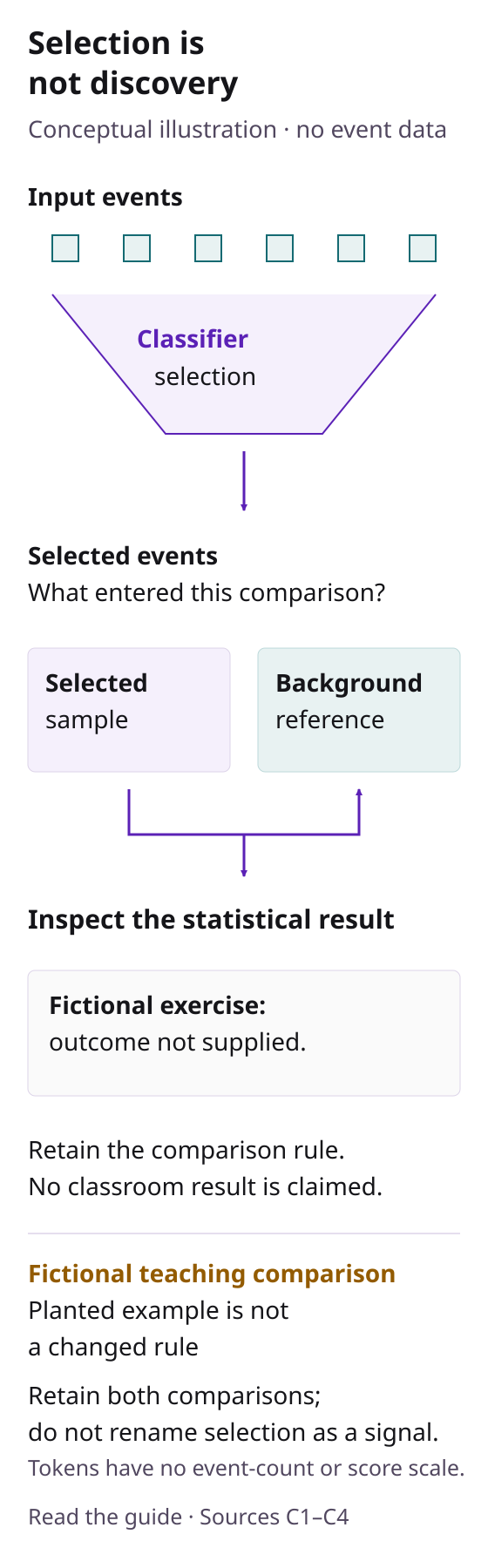
Original conceptual illustration supporting this article. Shapes and teaching examples are explanatory, not measured data, an authentic laboratory interface or an independent reproduction. Read the accompanying source-linked guide.
[Open the complete diagram](/assets/science-collider-selection-concept-20261016.svg)
Selection is not discovery
A fictional, unperformed selection exercise. The squares are symbols, not detector events, and no histogram or significance result is generated here.
Keep a planted example separate from a changed rule
Read the funnel as a hypothetical rule deciding which classroom cards enter a comparison. Keep the selected cards and the reference in separate labelled boxes. Their equal drawn sizes are a layout choice, not a claim that the sets contain the same number of cards.
In the invented exercise, retain one comparison with a planted example and another whose selection rule changed. Write down the rule before looking at the concealed labels. Keep an inconvenient comparison rather than relabelling exploration as confirmation. No threshold, score, sensitivity or discovery criterion is supplied by the artwork.
The middle outcome box is deliberately unanswered in this fictional worksheet. Read the unchanged article for actual research reporting. This exercise cannot verify that reporting or exclude other possibilities. No CERN dataset, collision archive, institutional display or search program was used here.
Readable figure labels
- Selection is - not discovery - Conceptual illustration · no event data - Input events - Classifier - selection - Selected events - What entered this comparison? - Selected - sample - Background - reference - Inspect the statistical result - Fictional exercise: - outcome not supplied. - Retain the comparison rule. - No classroom result is claimed. - Fictional teaching comparison - Planted example is not - a changed rule - Retain both comparisons; - do not rename selection as a signal. - Tokens have no event-count or score scale. - Read the guide · Sources C1–C4
Source context
For the reported facts, dates and access limitations, read the unchanged article above. These are the same underlying references, not additional experiments. The fictional exercise and diagram do not establish a measured result.
- [C1](https://arxiv.org/html/2502.09770v2) - [C2](https://atlas-public.web.cern.ch/Updates/Briefing/Anomaly-Detection) - [C3](https://cms-results.web.cern.ch/cms-results/public-results/publications/MLG-23-002/) - [C4](https://atlas.cern/Resources/Opendata)