What IISc's turbine-wake model offers a student of scientific AI
Public IISc research materials offer an entry into physics-informed numerical modelling, while the unavailable publisher full text sets a clear limit on performance reporting.
A turbine's wake is a useful subject for scientific machine learning because the model must connect a physical description with a spatial prediction. A January 2025 Physics of Fluids paper, involving Indian Institute of Science researchers and collaborators, studies a physics-informed neural network for turbulent wakes. Its public abstract and author software describe numerical research, not measured improvements in a working wind farm. [Paper record](https://doi.org/10.1063/5.0245113).
There is an important reading limitation here. The publisher's full text was not accessible during this research check. The discussion of that paper is consequently restricted to its public abstract, bibliographic record and separately available author materials. No unexamined table is being used to claim a speed increase, a particular error rate or a gain in electricity production.
The author repository gives the project a more inspectable shape. It contains training and post-processing materials for turbine-wake cases, alongside simpler flow examples and trained checkpoints. Its README describes a loss based on Reynolds-averaged Navier–Stokes equations and problem-specific boundary information. Those are numerical modelling ingredients; public files alone do not demonstrate operational acceptance at a turbine site. [IISc laboratory software](https://github.com/quest-lab-iisc/PINN_WakeTurbulenceModel).
What physics contributes to the learning task
The foundational physics-informed learning work by Raissi and colleagues describes incorporating differential-equation information into neural-network training. Instead of learning only from paired inputs and outputs, the model can also be penalised for violating a specified equation. That approach provides a way to use a mathematical model of a system; it does not guarantee that the chosen equations or conditions capture every relevant phenomenon. [Foundational method](https://arxiv.org/abs/1711.10561).
For a newcomer, the useful question is what the constraint means in the particular problem. A small training loss can be encouraging without answering every scientific question about a predicted flow. A proposed reading note should identify the equations, boundary information and comparison reference separately. Calling the network physics-informed should begin that inspection, rather than end it.
IISc's annual report for 2024–25 identifies the turbine-wake research and the availability of trained materials. The report provides institutional context for the project. It is not a separate independent replication or evidence of a currently deployed control system. Its reporting period should also remain distinct from the journal article's date and from a repository release date. [Institutional research record](https://www.iisc.ac.in/wp-content/uploads/2026/02/Annual-Report-2024-25.pdf).
That chronology is useful to a student deciding what to study first. Begin with a stable description of the problem, then locate the corresponding public materials and record what version is actually present. A later institutional account can help locate the work, but it should not silently become evidence for performance claims absent from the paper or measured data.
The repository includes separate flow cases, including turbine-wake and channel-flow material. The existence of these directories should not be treated as proof that a single trained model generalises across all of them. A prospective user needs to identify which input conditions belong to which checkpoint and which comparisons were intended. [Available research materials](https://github.com/quest-lab-iisc/PINN_WakeTurbulenceModel).
Why constraints need their own evaluation
A primary NeurIPS study on possible PINN failure modes shows that optimisation can struggle even for relatively simple differential-equation problems. Its examples investigate convection, reaction and diffusion, and examine changes to training strategies. This is methodological evidence about the approach, not a direct test showing that the IISc turbine model failed. [Failure-mode research](https://papers.neurips.cc/paper_files/paper/2021/hash/df438e5206f31600e6ae4af72f2725f1-Abstract.html).
That result suggests a concrete question for a proposed learning project: where is agreement being checked? Do not examine only the points selected for training. Ask whether a model gives a sensible answer at separately chosen locations and under the conditions actually represented by the reference. A visually smooth field can still leave the intended comparison unanswered.
The foundational method distinguishes information supplied through observations from information imposed by the equation. A useful study record should do the same. Record which values are known at the boundary, which are examples inside the domain and which quantities the network is expected to infer. That distinction makes an apparently successful prediction easier to interpret. [Method formulation](https://arxiv.org/abs/1711.10561).
For the turbine-wake case, a future comparison should also state what the reference represents. A numerical reference, a controlled experiment and a field measurement are different sources of information. This article does not claim the accessible materials establish all of those comparisons. Before reproducing a result, a researcher should locate the relevant definitions and obtain any missing material through an ordinary authorised route.
An invented exercise with a hidden boundary change
Imagine a classroom exercise containing a fictional rectangular flow domain, a supplied reference field and a deliberately simplified equation. Students receive boundary values and a separate set of interior comparison points. Everything is synthetic, and no turbine or wind-farm data is used. This proposed exercise has not been executed and has no claimed performance result.
Each group first writes down which information its model may use. One group is then given a second synthetic reference whose boundary has changed. Before retraining, students must decide which parts of their original setup are still meaningful. The exercise asks whether the scientific question changed, rather than merely whether the software can produce another colourful image.
A worked comparison would place predictions and reference values at the same declared locations. Its conclusion is that agreement under the original boundary does not settle the changed-boundary case. Students would retain both comparisons, including disagreements. If the model only matches training locations, that stays visible. There is no invented percentage target or suggestion that this example estimates a real turbine's wake.
The final task is to write a handover for another group. It should specify units, coordinates, boundary conditions and which reference was used, while identifying what has not been evaluated. Another student should be able to understand the comparison without guessing which of several checkpoint files happened to produce the most attractive contour plot.
Reuse requires a problem description, not only a checkpoint
The author repository's released checkpoints make it possible to inspect the intended reuse materials. They do not eliminate dependency checks, licence review or the need to understand each case. This publication has read the available documentation; it has not installed the repository, run training or validated a checkpoint against a flow dataset. [Author release](https://github.com/quest-lab-iisc/PINN_WakeTurbulenceModel).
The failure-mode research is helpful precisely because it examines a method rather than a particular energy product. It gives learners questions to carry into a replication: how the optimisation behaves, which conditions are difficult and whether an altered training procedure changes the result. Those questions should be asked without assigning an unobserved defect to the IISc work. [Methodological limitations](https://papers.neurips.cc/paper_files/paper/2021/hash/df438e5206f31600e6ae4af72f2725f1-Abstract.html).
For scientific-software teams, a useful contribution could be clearer case descriptions and comparison records, subject to the original project's licence and authorship. For students, it could be a carefully documented reading and replication proposal. Neither requires claiming an operational deployment, a turbine-control capability or a measured economic benefit that the examined public evidence does not establish.
This work offers a concrete Indian research example of combining learning with a mathematical flow description. Its practical value for a new reader is the path from equations and conditions to an inspectable numerical question. Following that path carefully is more informative than treating a smooth wake illustration as proof that scientific or engineering validation has already been completed.
Conceptual diagram and reading companion
Original conceptual illustration and unperformed classroom exercise; no measured data, authentic research interface or reproduced result is shown.
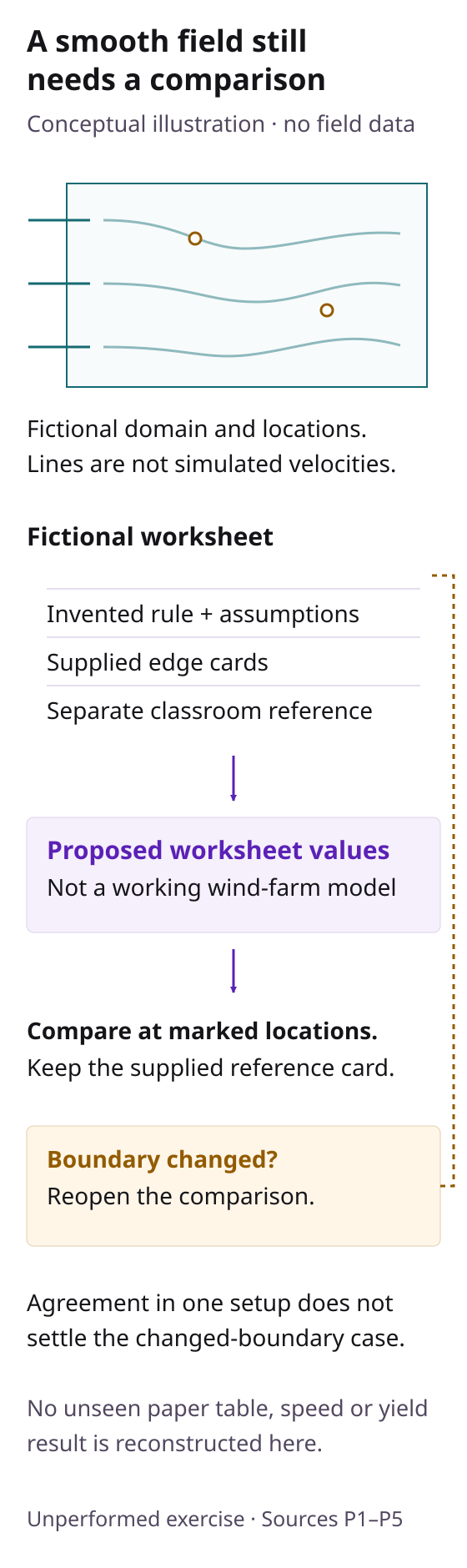
Original conceptual illustration supporting this article. Shapes and teaching examples are explanatory, not measured data, an authentic laboratory interface or an independent reproduction. Read the accompanying source-linked guide.
[Open the complete diagram](/assets/science-iisc-wake-boundaries-concept-20261016.svg)
A smooth field still needs a comparison
A fictional numerical-question worksheet. Lines and circles are neither a simulated field nor measurements from a wind farm.
Reopen the invented comparison when its boundary changes
Read the rectangle as a classroom problem sheet. Record its supplied rule, boundary information and separately chosen comparison locations. The pale lines have no velocity scale; the outlined circles are proposed places to compare values, not successful tests. No checkpoint or field is evaluated here.
The amber return asks a learner to revisit the question after a fictional boundary changes. Keep the first and second comparison together, including disagreement. Do not silently treat a new sheet as a continuation of the same accepted case. This guide supplies no target percentage or proposed transfer to turbine control.
For a hypothetical handover, state the units, coordinates and source of the reference that would be used. The original article retains its actual source-access limitations. This companion does not reconstruct an unseen paper table, run training or turn a smooth drawing into a speed, energy, cost or yield result.
Readable figure labels
- A smooth field still - needs a comparison - Conceptual illustration · no field data - Fictional domain and locations. - Lines are not simulated velocities. - Fictional worksheet - Invented rule + assumptions - Supplied edge cards - Separate classroom reference - Proposed worksheet values - Not a working wind-farm model - Compare at marked locations. - Keep the supplied reference card. - Boundary changed? - Reopen the comparison. - Agreement in one setup does not - settle the changed-boundary case. - No unseen paper table, speed or yield - result is reconstructed here. - Unperformed exercise · Sources P1–P5
Source context
For the reported facts, dates and access limitations, read the unchanged article above. These are the same underlying references, not additional experiments. The fictional exercise and diagram do not establish a measured result.
- [P1](https://doi.org/10.1063/5.0245113) - [P2](https://github.com/quest-lab-iisc/PINN_WakeTurbulenceModel) - [P3](https://www.iisc.ac.in/wp-content/uploads/2026/02/Annual-Report-2024-25.pdf) - [P4](https://arxiv.org/abs/1711.10561) - [P5](https://papers.neurips.cc/paper_files/paper/2021/hash/df438e5206f31600e6ae4af72f2725f1-Abstract.html)